Guide : Règles de navigation en Kite, Wing, Windsurf
Le RIPAM, Règlement International pour Prévenir les Abordages en Mer, est le texte de 34 pages qui décide sur l'eau qui manœuvre et qui garde son cap.
En résumé
- Kitesurf, wing foil, planche à voile et paddle sont considérés comme des engins de plage, mais ces règles de bon sens s'appliquent à eux comme aux navires.
- En résumé Sur l'eau il n'y a pas de priorité, seulement des privilèges : chacun doit manœuvrer pour éviter un abordage.
- Le principe unique : c'est toujours au plus manœuvrant de laisser le privilège au moins manœuvrant, en fonction de son état et non de son support.
- 9 règles simples et 2 règles d'or encadrent la navigation en kite, wing et windsurf.
Le RIPAM, Règlement International pour Prévenir les Abordages en Mer, est le texte de 34 pages qui décide sur l'eau qui manœuvre et qui garde son cap. Kitesurf, wing foil, planche à voile et paddle sont considérés comme des engins de plage, mais ces règles de bon sens s'appliquent à eux comme aux navires.
En résumé
Sur l'eau il n'y a pas de priorité, seulement des privilèges : chacun doit manœuvrer pour éviter un abordage.
- Le principe unique : c'est toujours au plus manœuvrant de laisser le privilège au moins manœuvrant, en fonction de son état et non de son support.
- 9 règles simples et 2 règles d'or encadrent la navigation en kite, wing et windsurf.
- Pour sauter : 50 m dégagés sous le vent et 30 m au vent.
- Règle d'or : au vent on garde l'aile HAUTE, sous le vent on la garde BASSE.
- Perte de matériel en mer : appeler le CROSS au 196, et avoir son nom et son téléphone sur l'aile et la planche (c'est obligatoire).
► Sun, sex & priorities:
The sun and wind are back on our coasts! But with the sun come holidays, and sometimes overcrowded spots.
To avoid accidents in kite, wing, and surf and make the most of sunny sessions, it's important to follow a few basic rules.
On the water, you might encounter different users: fishermen, professional mariners, professional recreational boaters, and recreational boaters.
The first three groups have received professional training and are expected to know maritime rules. Recreational boaters have a more vague understanding. While some have obtained their boating licenses, very few have actually read the COLREGs.
Since ignorance of the law is no excuse, but no one has actually read all the texts, a brief overview seems useful to popularize the 34 pages of the COLREGs.
At sea, it's the COLREGs (International Regulations for Preventing Collisions at Sea) that dictate our conduct. Even though this document is published for vessels, and kitesurf, wing foil, windsurf, and Stand Up Paddle are considered beach craft, we must respect these common-sense rules written in black and white.
Source et limites
Le texte de référence est le RIPAM publié par le Shom. Ce guide en propose une lecture pratique pour les sports de glisse : il ne remplace ni le texte officiel, ni les arrêtés locaux, ni les consignes du poste de secours. Les distances et usages indiqués restent des repères de sécurité à adapter au spot, à la météo, au niveau des pratiquants et à la fréquentation.
► At sea, vessels are divided by their "status," not their size or the captain's age.
- First distinction:
There are vessels with mechanical propulsion and vessels with sail propulsion.
- Second distinction:
Vessels engaged in fishing, vessels not under command, vessels restricted in their ability to maneuver, constrained by their draft, vessels not maneuvering, and vessels underway.
On the water, whether kitesurfing, wing foiling, windsurfing, or surfing, we can categorize things this way:
- Vessels engaged in fishing: not very common in kitesurf or wingfoil, but some do SUP trolling, so beware!
- Vessels not under command: these can be likened to riders who are out of control, with a broken line, torn kite, etc.
- Vessels with restricted maneuverability: these can be likened to riders entering the water, body dragging, or surfing a wave.
- Vessels constrained by their draft: foilers at launch. But especially beginners in school in their lesson area, which could be likened to their channel.
- Vessels not maneuvering: riders who have just taken a big wipeout, or a rider about to do their waterstart.
- Vessels underway: these are all riders navigating, regardless of their equipment-kite, kite foil, wing foil, windsurf board, fun board, paddle surf, SUP...
To simplify, it is always the more maneuverable vessel that must give way to the less maneuverable, based on its status and not its equipment!

► There are 9 simple rules and 2 GOLDEN rules in Kite, Wing, Windsurf:
Rule #1:
The rider entering the water from the beach has priority over the rider already navigating. Some think the opposite, especially in kitesurf...
Rule #2:
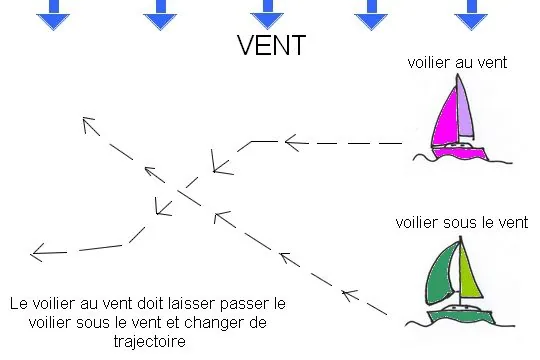
When crossing paths, the upwind kite rider keeps their kite high and the downwind rider lowers it. You must not obstruct riders who are downwind of you.
Rule #3:
The rider on port tack (front foot is the left foot) must maneuver when facing a starboard tack rider. The starboard tack rider must maintain their course and speed. If the port tack rider does not maneuver, the starboard tack rider must act, because there is no absolute priority on the water, only privileges, and everyone must avoid a collision.
Rule #4:
When two riders are moving in the same direction, the faster rider must give way to the slower rider ahead of them. The overtaken rider does not lose their privilege once the passing maneuver is completed.
Rule #5:
Look around before making a change of direction. Any change in course or speed, or both, must be significant enough to be immediately perceived by any other rider observing it.
Rule #6:
The rider surfing a wave has priority over someone jumping or going in the opposite direction. This rule is unfortunately too rarely respected at wave spots.
Rule #7:
Priority must be given to other ocean and beach users who are not navigating. The rider must move downwind of them.
Rule #8 :
To jump, a rider must have a clear safety zone of 50m downwind and 30m upwind.
Rule #9 :
When two practitioners are on the beach at the same time, one kitesurfer is about to enter the water and the other is ready to land, both must keep clear of each other.
☼ Golden Rule #1:
If you pass upwind, keep your kite HIGH.
If you pass downwind, keep your kite LOW.
☼ Golden Rule #2:
Respect and common sense
► Common Sense in Kite, Wingfoil, and Windsurf:

I cross a wingfoiler or windsurfer while kiting: let the wingfoiler or windsurfer pass upwind, even if the kiter is on starboard tack. This simplifies things for everyone, because for the wing or windsurf mast to pass under a kite's lines, the kiter must bear away significantly.
I cross a wingfoiler or windsurfer while kiting: they are struggling to pass the bar because there isn't enough wind compared to the swell they have to face. Be nice, give them space.
I'm kitesurfing, wingfoiling, or funboarding, and there are paddle surfers around: It can be nice to let a surfer pass and then catch the next wave...
Jumping between swimmers or surfers: even if the water is flatter among swimmers, is the risk worth it?
I do my waterstart, and I wait for the active rider to pass me.
Do not ride in a prohibited spot, that's basic.
Do not ride in swimming areas, still and always basic.
Respect the take-off zones.
► In case of breakage or equipment abandonment at sea:
Call the safety services (CROSS number: 196) in case of lost equipment to avoid sending out rescue services unnecessarily, and most importantly, put your name and phone number on your kite and board so that rescue services can call you and avoid searching for you at sea for hours (it's mandatory, GlissEvolution offers you stickers to label your equipment).
► The Most Common Mistakes / Urban Legends of Kitesurfing and Wingfoil:

#I have priority!
At sea, there are no priorities, only privileges. The difference is important. Everyone must maneuver to avoid a collision!
"Every vessel must use all available means that are appropriate to the existing circumstances and conditions to determine if there is a risk of collision. If there is any doubt as to the risk of collision, it must be assumed that such risk exists."
#Starboard tack, king of the seas!
Starboard tack or not, depending on the situation, you may have to give way. A rider sailing downwind, a rider slower than you are overtaking...
#I'm overtaking and maneuvering as if I were alone in the world!
The overtaking rule requires the overtaking vessel to give way until all risk of collision is averted.
#I'm a beginner, I have priority!
If the beginner rider is in a designated Kite lesson area with appropriate markings, yes. But when riding with full range, certainly not. This doesn't prevent an experienced rider from avoiding them. Avoid or pass under their Kite, and complain because the beginner made their Kite fall on them...
#I'm on a windsurf board, I have priority because I'm less maneuverable...
This is a pure urban legend. It is always the more maneuverable vessel that must give way to the less maneuverable vessel, depending on its condition and not its type of craft!
However, letting a surfer paddling surf while you're on a wing, kite, or windsurf board, that's good etiquette!
#I have a sailboat with the engine on, I have priority over a motorboat!
Engine on means mechanical propulsion, full stop.
By the way, you can see it in your wake; a boat sailing solely by sail doesn't create turbulence...
#I'm doing my port maneuvers under sail, I'm going first!
Port maneuvers under sail are prohibited, so no privileges... However, some boats are not equipped to receive an engine and their users do not want to install mechanical assistance or row, so they are forced to tack. Don't look for it, these are purists. And are you really in that much of a hurry?
► Kite, Wingfoil, and Windsurf Glossary:
Vessel:
Any craft or apparatus of any kind whatsoever, including non-displacement craft such as seaplanes, used or capable of being used as a means of transportation on water.
Privilege:
A particular advantage considered to confer a favor.
Priority:
The right to pass before another or others, by virtue of a regulation, law, etc.
Tacks:
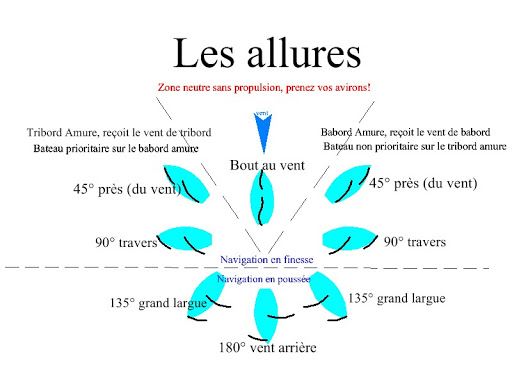
The tack is the side of the boat first touched by the wind. There are two starboard tacks and port tacks. If you face the direction of the boat's travel and it takes the wind from the right, you are on starboard tack; from the left, it's port tack. That's the theory!
In wing, kite, or windsurfing, we think more simply: if your right hand is forward, you are on starboard tack. If your left hand is forward, you are on port tack.
COLREGs:
International Regulations for Preventing Collisions at Sea, which dictate our good conduct at sea. Even though this document is published for vessels, and kitesurfing, wing foiling, and paddleboarding are considered beach craft, we must respect these common-sense rules written in black and white.
Upwind:
The expression "upwind" is used to locate an object in space by indicating that it is on the side from which the wind is blowing, relative to a reference object. Thus, the object is beyond a line perpendicular to the wind passing through the object, and receives the wind before the reference object.
Downwind:
The expression "downwind" is used to locate an object in space by indicating that it is on the opposite side from which the wind is blowing, relative to a reference object. Thus, the object is beyond a line perpendicular to the wind passing through the object, and receives the wind after the reference object.
Luffing / Bearing Away in Kite, Wingfoil, and Windsurf:
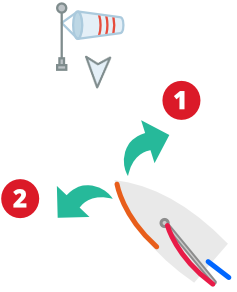
Either you head closer to the wind: this is called luffing (1).
Or you head away from the wind: this is called bearing away (2).
A sudden change in direction (of course) is called a yaw. There is:
Auloffée: if the boat luffs.
Abatée: if the boat bears away.
| Règle | Situation | Qui a le privilège |
|---|---|---|
| #1 | Un pratiquant entre dans l'eau depuis la plage | Celui qui entre à l'eau, pas celui qui est déjà en navigation |
| #2 | Croisement entre deux kites | Le kite au vent met son aile en hauteur, celui sous le vent la baisse |
| #3 | Bâbord amure croise tribord amure | Tribord amure maintient cap et vitesse, bâbord amure manœuvre, sans quoi tribord doit agir |
| #4 | Deux riders dans la même direction | Le plus lent qui précède ; le rattrapant cède le passage jusqu'à écarter tout risque |
| #5 | Changement de cap ou de vitesse | Regarder autour de soi ; le changement doit être assez franc pour être perçu immédiatement |
| #6 | Un rider surfe une vague | Celui qui surfe, avant celui qui saute ou qui vient en sens inverse |
| #7 | Usagers non en navigation (baigneurs, plage) | Eux ; le rider se déplace sous leur vent |
| #8 | Saut | Zone de sécurité claire de 50 m sous le vent et 30 m au vent |
| #9 | Un kiteur décolle pendant qu'un autre atterrit | Les deux se tiennent à l'écart l'un de l'autre |
Questions fréquentes
Y a-t-il une priorité en kitesurf ?
Non. En mer il n'y a pas de priorités, seulement des privilèges, et la nuance est importante : chacun se doit de manœuvrer pour éviter un abordage. Le RIPAM demande d'utiliser tous les moyens disponibles pour déterminer s'il existe un risque d'abordage, et de considérer que ce risque existe en cas de doute.
Qui a le privilège entre bâbord et tribord amure ?
Le rider bâbord amure manœuvre, le rider tribord amure maintient son cap et sa vitesse. Mais si bâbord ne manœuvre pas, tribord doit agir : il n'y a pas de privilège absolu. Repère simple sur l'eau : main droite à l'avant, on est tribord amure ; main gauche à l'avant, on est bâbord amure.
Quelle distance de sécurité faut-il pour sauter en kitesurf ?
Une zone claire de 50 m sous le vent (downwind) et de 30 m au vent (upwind). Sauter entre des baigneurs ou des surfeurs parce que le plan d'eau y est plus plat n'en vaut jamais le risque.
Un débutant est-il prioritaire sur l'eau ?
Seulement s'il se trouve dans une zone réservée aux cours de kite avec un marquage approprié, assimilable à un chenal. En autonomie, non. Cela n'empêche pas le rider confirmé de l'éviter et de passer sous son aile plutôt que de se plaindre après coup.
Que faire en cas de perte de matériel en mer ?
Appeler les services de sécurité au 196 (CROSS) pour éviter de faire sortir les secours pour rien. Et surtout, avoir son nom et son numéro de téléphone sur son aile et sur sa planche : c'est obligatoire, cela permet aux secours de vous appeler plutôt que de vous chercher en mer pendant des heures. GlissEvolution offre les stickers pour étiqueter le matériel.
Une question sur le matériel évoqué ici ?
L'équipe GlissEvolution navigue sur ce qu'elle vend et répond de vive voix.