Duotone Foil Assist: Electric Range Test and Review
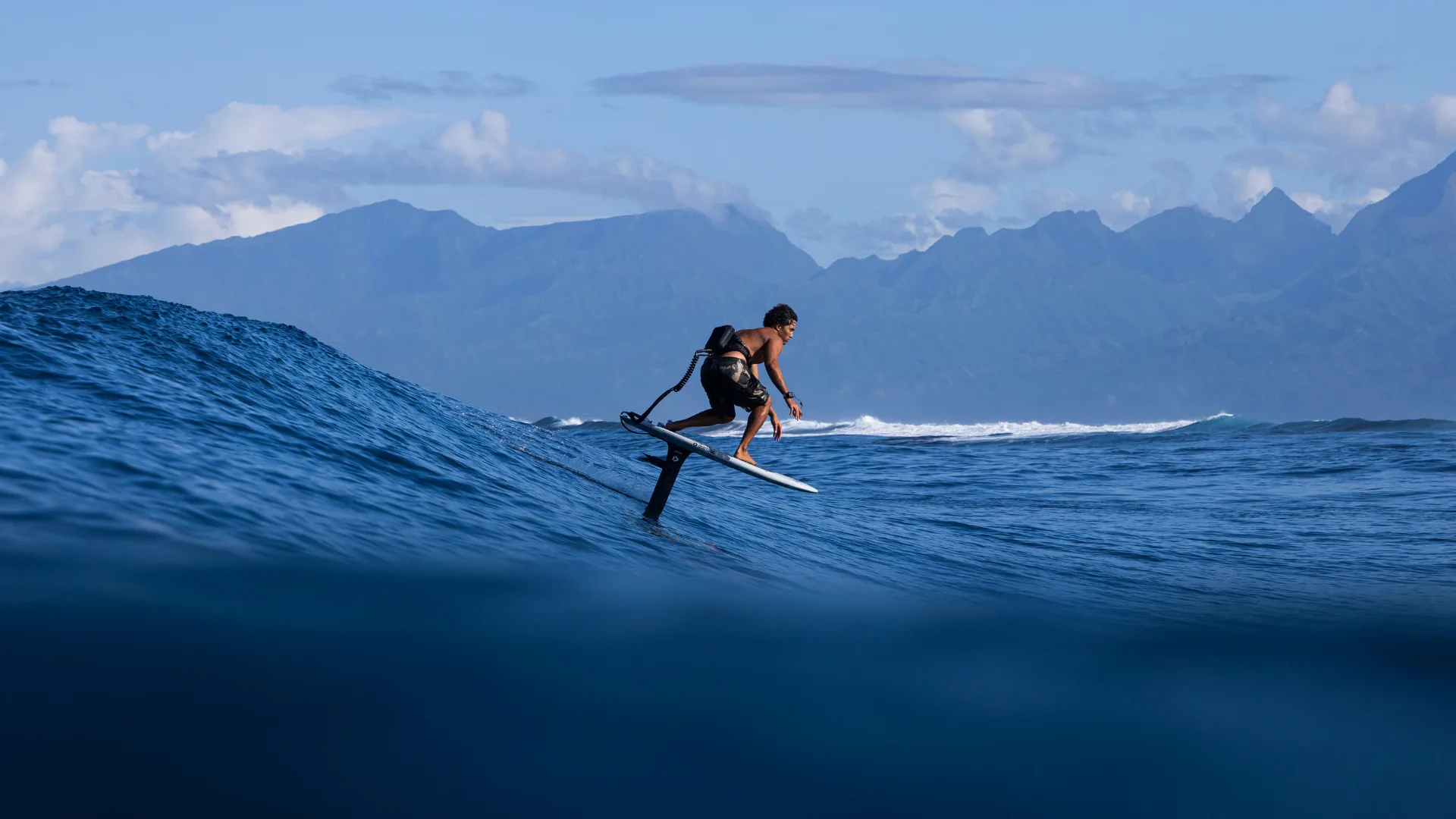
Assisted foil has changed the way we surf: a small motor, batteries, and the ability to catch unbreaking waves or get out when the wind drops. Duotone offers a different approach from the competition: the batteries are no longer on the board but around the waist. Hadou Brunner has put the complete range to the test on the water, and we'll summarize his verdict without distorting his words.
Thanks to Hadou Brunner for this comprehensive and detailed review. His video is embedded below: watch it in full and subscribe to his channel to support his work.
In this article
The Duotone Foil Assist is an assisted foil system where the motor is integrated into the mast and the two batteries are worn on a belt, not on the board.
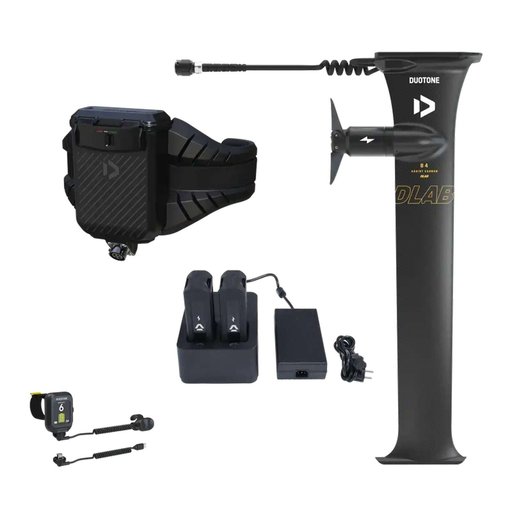
Three versions: Assist carbon D/Lab at €5.999, Assist aluminum at €4.799, and Cruise eFoil at €4.799, with an advertised thrust of 33 kg and 159.6 Wh batteries. The real gain, according to Hadou, is the shift of mass to the body: the board lightens, pumping and surfing are transformed. A true foil assist for surfing and pumping, more than a long-distance eFoil.
The Duotone Foil Assist Range at a Glance
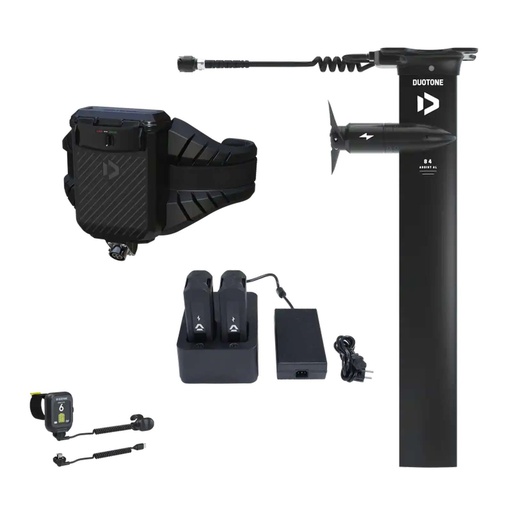
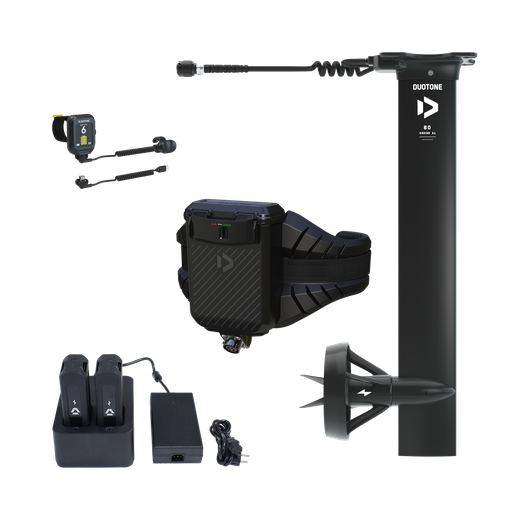
The range is viewed along two axes: the mast construction (carbon D/Lab or aluminum) and, most importantly, the motor's position, which defines its use. On the Assist versions, the motor is placed high (approximately 17 cm below the plate) for surfing and pumping. On the Cruise version, it descends close to the fuselage and remains submerged, for eFoil use. Here are the three systems and their actual in-store prices.
| System | Mast | Motor Position | Price (incl. VAT) |
|---|---|---|---|
| Foil Assist D/Lab (carbon) | Carbon D/Lab 84 cm | High, approx. 17 cm below the plate | €5,999 |
| Foil Assist AL | Aluminum 84 cm | High, below the plate | €4,799 |
| Foil Cruise AL (eFoil) | Aluminum 80 cm | Low, near the fuselage, submerged | €4,799 |
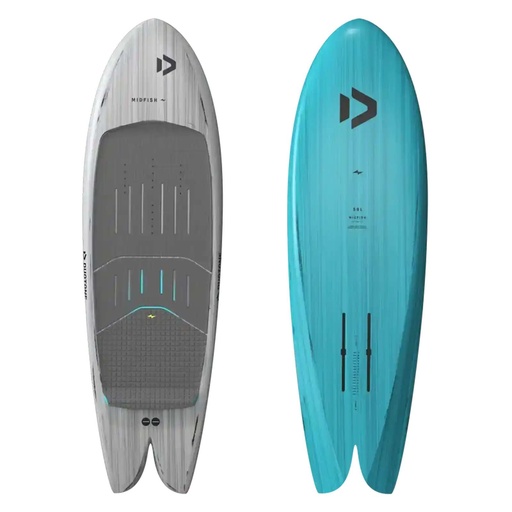
Complete ready-to-ride sets are also available, such as the Foil Cruise AL complete set with a carbon Midfish board. The motorized mast is available separately as the eMast D/Lab (€3.649), eMast alu or eMast alu Cruise (€2.449). Not sure which version? Contact us to match it to your riding style and foils.
Who is this foil assist for?
The strength of the Duotone system is the weight on the belt: the board remains light and lively, ideal for the foil surfer who wants to keep pumping with their legs, maintaining a rail-to-rail setup with minimal inertia. Downwind or parawing riders gain the safety of frequent restarts, and travelers benefit from batteries under 160 Wh. Those who already own foils from other brands appreciate the adapters on the aluminum version.
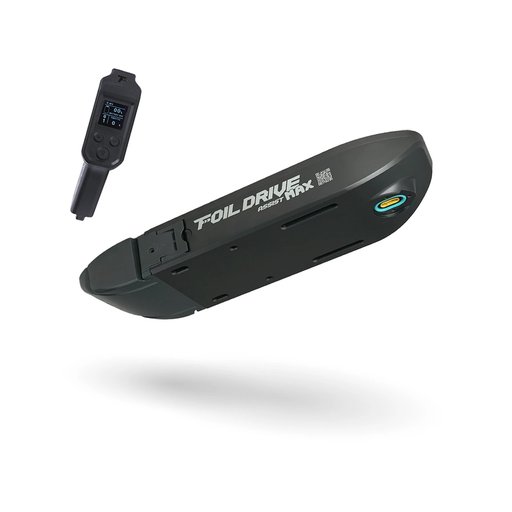
Conversely, it's not the tool for the pure eFoil rider: for larger riders or long motor-powered sessions, the range is quickly consumed, and a Foil Drive Assist Max would be more suitable. Riders who want a modulated throttle from the first session will also need to get used to the notched remote. To get started, see our complete guide to using the Duotone Foil Assist.
Our Detailed Review of the Duotone Foil Assist
The field feedback comes from Hadou Brunner, who has been practicing foil assist for over two years with a wide variety of setups. What interests him here: how much difference it really makes to move the batteries to the body.
Video Test: Hadou Brunner
The Concept: Belt-Mounted Batteries
Most systems house the motor and batteries on or just under the board. Duotone keeps the motor on the mast but places the two batteries in a waist harness, the eHarness. With the batteries on your body, the mass becomes a part of you, like muscle, while everything below the waist remains like a normal surf setup. The board becomes significantly lighter, which facilitates reconnecting to pumping and frees the foil from parasitic inertia in turns. This is the point Hadou emphasizes above all else. The system is not a homemade setup gone into production: Duotone is the first major brand to arrive with a certified solution, developed with a rider who has been using it for several years.
The Mast, Motor, and Batteries
The motor weighs approximately 1 kg and boasts 33 kg of thrust. It connects via a reinforced cable weighing about 500 g, which is actually a coiled sheath inside which a leash with a stainless steel carabiner passes: this absorbs impacts from falls, not the electrical cable. Two 159.6 Wh batteries (7 Ah, 22.8 V) work in tandem in the harness, for a belt-plus-batteries assembly weighing just under 3.8 kg, and a complete system around 6 kg. A full recharge of both takes 45 minutes, with a storage discharge mode for long periods. At 159.6 Wh, they fall below the common airline limit of 160 Wh (always check with your airline). The mast attaches with four M8 screws, is universal, and the aluminum version accepts adapters (approximately €99) for Armstrong, F-One, Code, SAB, AFS, Lift, North, Axis, or KT.
The Ring Remote and Safety
Here Duotone innovates: no trigger, but a wrist-mounted watch connected to an index finger ring with a plus and a minus button. You unlock with a double-click, then manage seven speeds with notches. Hands remain free for paddling or holding a camera, and the receiver housed in the belt is never submerged, so the signal doesn't cut out. True to its logic of simplicity, Duotone does not offer an app. For safety, the integrated leash in the sheath tightens in case of a fall, never the electrical cable, and a small bungee keeps the cable flat on the tail.
Boards and Foil
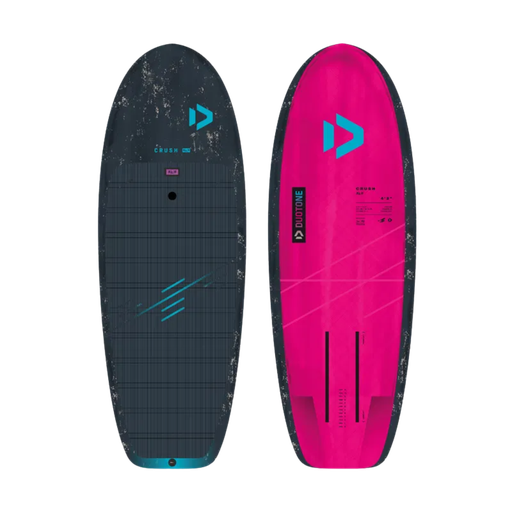
The dedicated board is the Midfish 2026, from 28 to 98 liters, around 4 kg: light, with good glide, it takes off early (Hadou even did parawing with the 5'2 in 38 liters). There is also a Midfish Air in large volume. But the surprise of the test comes from the Crush SLS in 27 liters, his favorite surf foil board this year: ultra-light, it starts no later than the Midfish and allows for longer pumping. For the foil, he used the Crest D/Lab, the 800 on flat water and the 675 as soon as conditions push for downwind. To transport the whole, there is a dedicated gearbag.
On the water: the sensations
At take-off, there's a pitching effect to control by leaning forward, similar to a Foil Drive. Advantage of the weight on the belt: when the hull touches the water, there's no motor under the board to snag. For his 62 kg, Hadou takes off at speed 5 with the aluminum two-blade propeller. The point that honestly bothered him was the notched remote control: it's impossible to modulate the pressure like with a trigger, and coming out of a wave he has to re-click several times to get back to his speed. He got used to it, but it remains less intuitive. Regarding range, he's concrete: almost an hour and 10 km on a flat eFoil test, more when there are waves to reconnect. The proper use is to leverage the elements and conserve the motor, not to pull on the control like on an eFoil.
Duotone Foil Assist or Foil Drive?
The two systems don't target exactly the same rider. The Duotone puts the weight on the body and favors a light, lively setup for surfing and pumping. The Foil Drive Assist Max, with its larger batteries, offers more range and a long-distance eFoil approach, but adds a bit more weight to the board. For pure eFoil, the Foil Drive retains the advantage; to keep a light board and continue pumping with your legs, the Duotone takes over. It's a choice of use, not budget.
In summary: our opinion on the Duotone Foil Assist
Duotone delivers a premium, well-finished, and complete offering, backed by excellent educational resources. The price remains high, but that's standard for this segment. The key takeaway is the relocation of the batteries to the body: for surfers who want to maintain the ability to pump with their legs, a light and lively setup offers a real advantage over previous systems. For pure eFoil, however, the range is consumed quickly, and a Foil Drive Assist Max remains more relevant. This is a sophisticated and distinct foil assist, designed to be used by playing with the elements.
FAQ: Duotone Foil Assist
What is the Duotone Foil Assist?
It's an assisted foil system with the motor integrated into the mast and two batteries worn on a belt in a harness, not on the board. It boasts 33 kg of thrust and is available as the Assist Carbon D/Lab at 5.€999, Assist Aluminum at 4.€799, and Cruise eFoil at 4.€799.
What's the difference between the Assist and Cruise versions?
On the Assist versions, the motor is positioned high, about 17 cm below the plate, allowing you to surf and pump with the propeller mostly out of the water. On the Cruise version, the motor is low near the fuselage and remains submerged; this is an eFoil setup where you fly high on the mast with continuous propulsion.
What is the range of the Duotone Foil Assist?
With the set of two 159.6 Wh batteries, expect approximately 30 minutes to just over an hour, up to 1.5 or 2 hours, depending on your weight, skill level, and usage. In a flat eFoil test, Hadou Brunner (62 kg) rode for nearly an hour, covering 10 km. A full recharge of both batteries takes 45 minutes.
Is the Duotone Foil Assist compatible with other foil brands?
Yes, the aluminum version offers adapters that slide into the top of the mast, providing compatibility with front wings from other brands (Armstrong, F-One, Code, SAB, AFS, Lift, North, Axis, KT) for around €99. The mast attaches to any board with four M8 screws.
Which board should you choose to start with Duotone Foil Assist?
The dedicated board is the Midfish 2026, ranging from 28 to 98 liters, around 4 kg, starting from €1,299. For a complete beginner, the brand recommends 35 liters more than your weight and a foil wing over 900 cm². A compact surf foil board like the Crush also works very well for lighter riders.
Duotone Foil Assist or Foil Drive: which to choose?
The Duotone places the weight on the body and is designed for surf and pumping with a light and lively setup. The Foil Drive, with its larger batteries, offers more range and a long-distance eFoil approach. For pure eFoil use, a Foil Drive Assist Max is more suitable; to keep a board light and pump with your legs, the Duotone has the advantage.
We'll help you choose
Carbon Assist, Aluminum Assist, or Cruise eFoil: the right choice depends on your practice, your size, and your current foils. Our team rides all year round and advises you, remotely or at the Pornichet store, to find the system that suits you.
Make an appointment Call us See the Foil Assist
Source: video review of the Duotone Foil Assist range by Hadou Brunner ("DUOTONE FOIL ASSIST COMPLETE REVIEW"). This article is a summary in French, published with our thanks; the opinions expressed are his own, transcribed without distortion. The prices indicated are those charged by GlissEvolution and may change; technical specifications are announced by Duotone.
 DUOTONE
 Duotone Electric