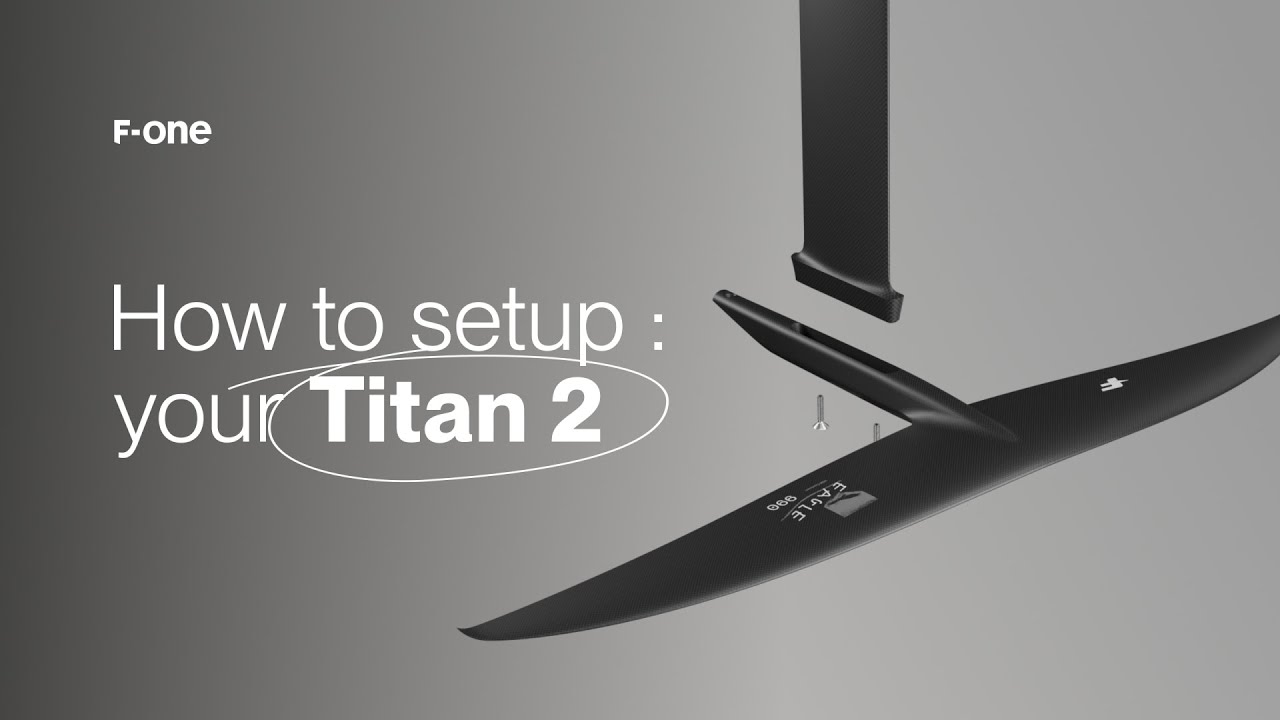
F-One TITAN 2: The New 2026 Foil Connection
F-One's TITAN 2 connection replaces the original TITAN system across the entire 2026 foil range. It uses 2 M8 screws instead of 3 M6 screws, providing increased stiffness, control, and reliability. After 8 years of service, F-One is evolving the core of its foils with a redesigned structural link. We'll explain what's changing, what it means for your current gear, and how to assemble the TITAN 2.
The TITAN 2 connection is the new F-One standard for linking the mast to the Front Wing.
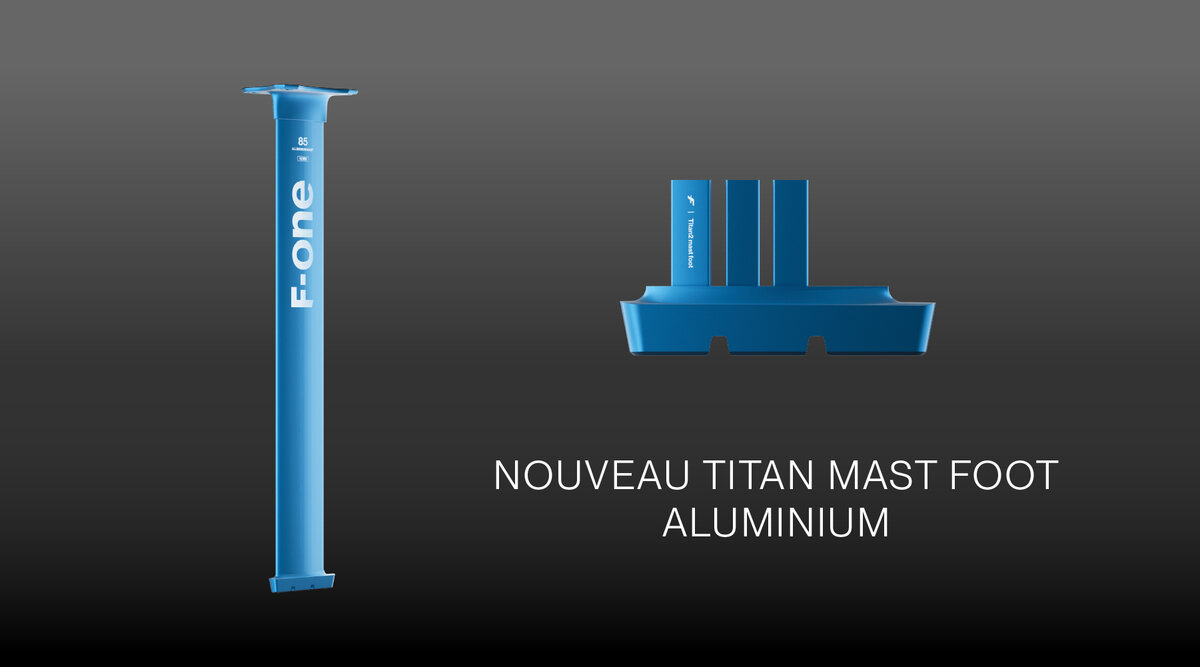
It uses 2 M8 x 25 mm screws (compared to 3 M6 x 32 mm screws on TITAN 1) for a stiffer connection and optimized energy transfer. If you ride with an aluminum mast, you just need to change the mast foot (€120). For carbon, you'll need a new mast and new Front Wings. FCT foils are not affected.
What is the TITAN 2 connection?
The Heart of the F-One Foil
For 8 years, the TITAN connection has been at the heart of all F-One foils. It connects the mast to the Front Wing, a critical junction point that determines the overall stiffness and the quality of the feel underfoot. With TITAN 2, F-One rethinks this connection in depth while maintaining the thin hydrodynamic design that is the brand's signature.
A Structural Change
The main change is structural: it moves from 3 M6 x 32 mm screws to 2 M8 x 25 mm screws. Fewer screws, but a larger diameter and a reinforced connection that eliminates mechanical micro-play. The mast foot presses directly against the base of the Front Wing, creating a unibody link between the mast and the lifting surface.
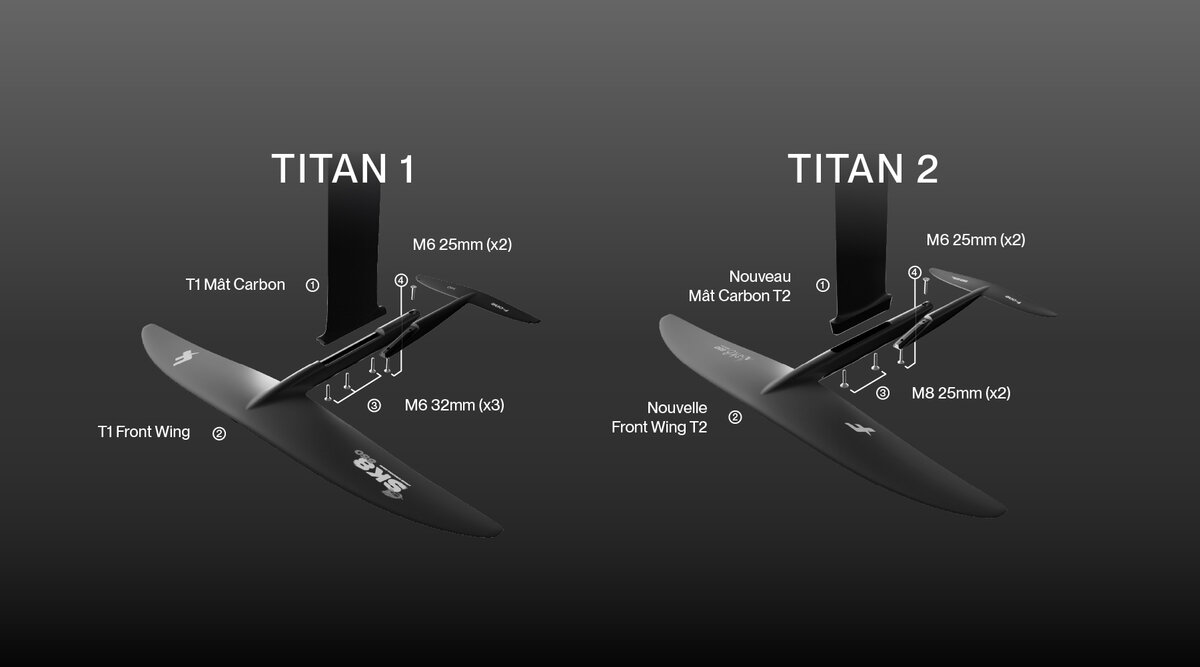
| Feature | TITAN 1 | TITAN 2 |
|---|---|---|
| Connection screws (mast → wing) | 3× M6 32 mm | 2× M8 25 mm |
| Top screws | 2× M6 25 mm | 2× M6 25 mm |
| Connection tightening torque | 12 N.m | 25 N.m |
| Top tightening torque | 12 N.m | 12 N.m |
| Fuselage profile | Hydrodynamic fin | Hydrodynamic fin (unchanged) |
| Cross-generation compatibility | - | Not backward compatible |
Why F-One redesigned the connection
Changing a standard that has worked for 8 years is not a decision taken lightly. To understand what prompted F-One to take the plunge, the R&D team recently shared a behind-the-scenes look at the development of the TITAN 2.
A legacy designed for aluminum
The original TITAN connection was designed at a time when F-One foils only existed in aluminum. The entire socket geometry was drawn around the properties of this material. When carbon masts arrived, F-One kept the same connection, but the adaptation was not straightforward. Carbon does not have the same mechanical constraints, and making TITAN 1 work with this material was already a compromise.
Rather than changing everything, engineers first explored all possible optimization avenues: improvements to screws, layups, inserts, and contact profiles. Each component was pushed to its limits. Despite these iterations, rider feedback was unanimous: the connection remained the weak link in the system. It prevented the full potential of the Front Wings and masts, which continued to progress, from being exploited. It was at this point that change became inevitable.
The hydro challenge: stiffness without sacrificing drag
The TITAN 1 had an advantage recognized by the entire community: very low drag thanks to a particularly thin hydrodynamic fuselage. Designing a stiffer connection without degrading this advantage represented a delicate balance between structure and hydro performance.
The R&D team went back and forth with Charles, the brand's hydrodynamic engineer: CFD analyses on fuselage dimensions, 3D printing prototyping, then on-water test sessions with team riders. Over the iterations, they also discovered that the fuselage not only affects drag but also directly influences the handling of the foil. An unexpected parameter that required additional work to ensure the same level of agility in turns as on the TITAN 1.
A Design Built for the Field
Beyond pure performance, F-One has integrated very practical considerations into the TITAN 2 socket design. The sweep angles present on the connection fulfill several functions. First, they make assembly intuitive: it's impossible to confuse front and back during mounting. Second, these angles allow for easy disassembly, without needing a mallet to extract the parts, even after intense sessions.
There's also a longevity advantage. On a connection with vertical walls, the mast and fuselage surfaces rub against each other with every stress, leading to rapid wear. The inclined walls of the TITAN 2 offer a more progressive insertion, which significantly reduces friction and extends the lifespan of the assembly.
Initial Field Feedback
From the first functional versions, the F-One team testers noticed an immediate change: they could ride higher on the mast, with the foil closer to the surface. This is a reliable indicator of increased stiffness. The stiffer and more secure the foil, the more you can reduce flight height, which decreases the drag of the submerged mast.
The cascading result is direct: better pumping, more precise turns, more potential to exploit in each session. The entire behavior of the foil benefits, whether in wing, surf, or downwind. It's this concrete gain, validated on the water by the team riders, that confirmed the TITAN 2 delivered on its promises even before going into production.
The 5 On-Water Advantages
The TITAN 2 is not just a simple screw set change. The 2 M8 screws and the new contact geometry concretely modify the foil's behavior. Here's what you'll feel:
- Optimized Energy Transfer, the M8 connection reduces micro-flexions at the mast/wing junction point. The energy from your foot pressure goes directly into the foil, without loss: every pump is more efficient.
- Better Control, less mechanical play, therefore more precision in your foot pressure. You feel better what the foil is doing under your feet, and your corrections are transmitted instantly.
- More Direct Feel, the increased stiffness of the connection creates a "monobloc" foil sensation. Feedback is immediate: you know exactly what's happening underwater.
- Increased Reliability, Two larger diameter M8 screws withstand stress better than three M6 screws. Less risk of loosening, less wear over time, less care.
- Overall Comfort, eliminating unwanted vibrations at the connection results in a smoother, more stable ride, both on long tacks and when wave riding.
Compatibility: What's the impact on your gear?
This is the question all F-One users are asking. The answer depends on your current setup. Here are the 3 scenarios:
Aluminum Mast: Simple and Economical
If you're riding with an F-One aluminum mast, the transition is the simplest: you just need to replace the mast foot with the new TITAN 2 compatible Titan Mast Foot. Your aluminum mast remains the same; only the mast foot changes. Upgrade cost: €120.
Carbon Mast: More Significant Change
For carbon mast users, the transition is more significant. Since the TITAN 2 connection is integrated into the mast, you need to replace both the carbon mast and the Front Wings with TITAN 2 compatible versions. There is no adapter; this is a deliberate choice by F-One to ensure optimal performance of the new connection.
FCT Foils: Nothing Changes
If you own an FCT (Foil Compression Technology) foil, you are not affected by this change. The FCT system uses a different connection that is not impacted by TITAN 2. Similarly, Monobloc Tails stabs are not affected.
| Current Configuration | What Changes | Estimated cost |
|---|---|---|
| Aluminum mast + TITAN 1 | Replace mast foot only | €120 |
| Carbon mast + TITAN 1 | New carbon mast + new Front Wings | Varies by model |
| Foil FCT | Nothing, not applicable | €0 |
| Monobloc Tails | Nothing, not applicable | €0 |
No TITAN 1 → TITAN 2 adapter
F-One does not offer an adapter between the two generations. TITAN 1 carbon masts are not compatible with TITAN 2 wings, and vice versa. This is an important point to consider when upgrading your gear.
Great deal: TITAN 1 Front Wings on sale
With the arrival of the TITAN 2, the entire range of TITAN 1 Front Wings is now on sale. It's the perfect time to complete your quiver or get equipped at a reduced price.
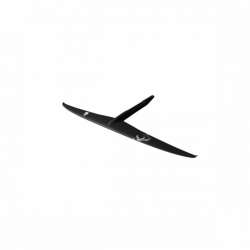
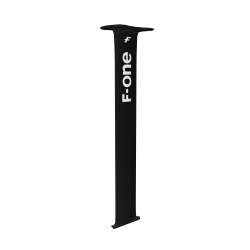
How to Assemble the TITAN 2
Step-by-Step Assembly
Assembling the TITAN 2 is simple but requires following a few precise steps. Start by inserting the Front Wing onto the mast foot, aligning the mounting holes. Apply downward vertical pressure to ensure a perfect fit between the mast foot and the wing's fuselage. The contact should be firm.
Next, place the two M8 screws into the mounting holes, then progressively tighten them by alternating between the front and rear screws, in small increments. Never fully tighten one screw before the other. Once a good pre-tightening is achieved, finish with the rear screw, then the front screw. As you tighten, the mast foot will descend and press against the base of the wing: this is normal and desired.
Disassembly and Torque Settings
For disassembly, unscrew the plane (wing + stab) leaving the mast on the board. Since the fit is very tight, it can be difficult to separate the plane from the mast. In this case, hold the fuselage with one hand and tap lightly upwards on the stab. The plane will pivot forward and disengage from the mast.
Tightening torques
M8 screws (TITAN 2 connection): 25 N.m
M6 screws (top): 12 N.m
Do not overtighten to the point of damaging the screw heads. Use a torque wrench.
Required equipment
TITAN 2 mast (carbon or aluminum with TITAN 2 mast foot) Front Wing TITAN 2 2 M8 screws (supplied) Suitable Torx key Torque wrench recommended.
The F-One foil 2026 range
The TITAN 2 connection equips the entire F-One foil 2026 range. Whether you're into freeride, Surf, performance, or downwind, all models benefit from this new connection:
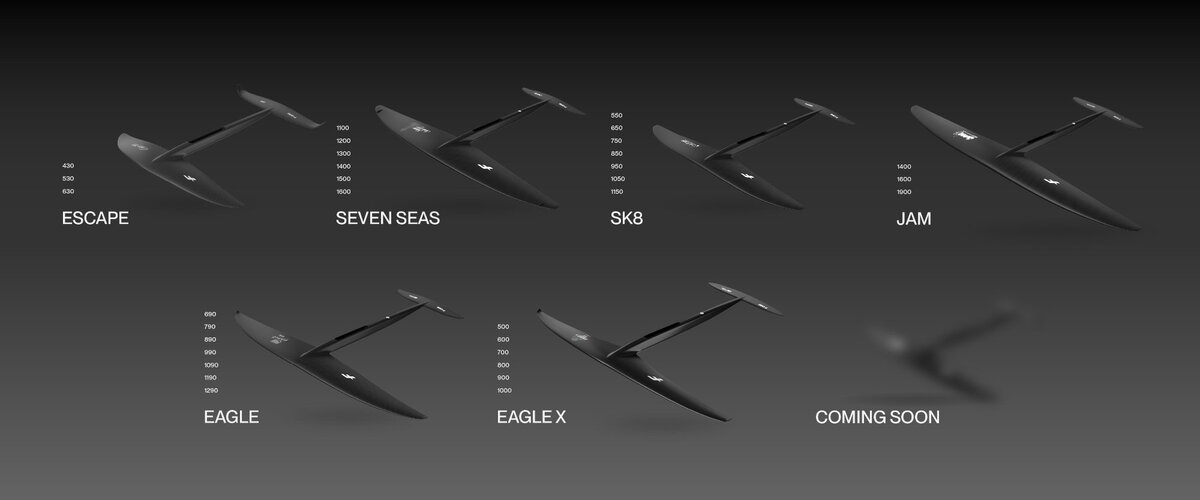
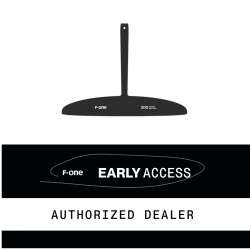
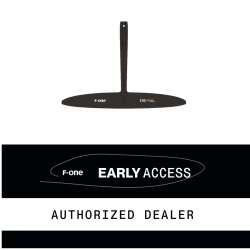
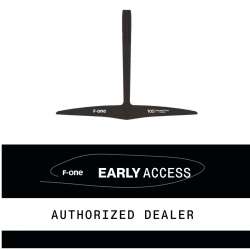
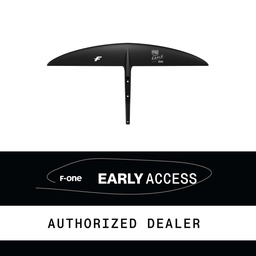
TITAN 2 Front Wings





Stabs (stabilizers)
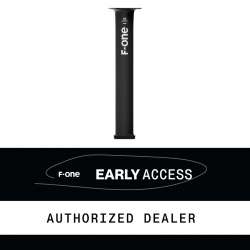
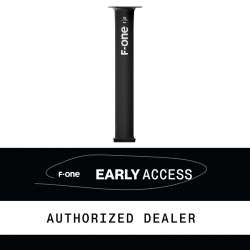
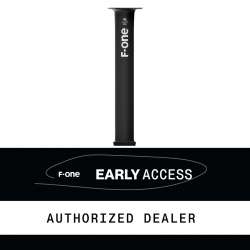
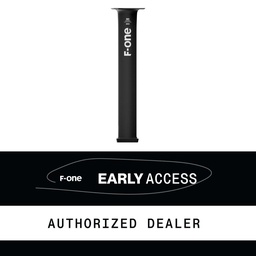
TITAN 2 Carbon Masts

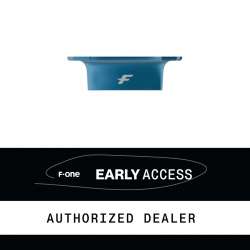
TITAN 2 Accessories

Frequently Asked Questions
Is TITAN 2 backward compatible with TITAN 1?
No. The two systems use different screw sets and geometry (M8 vs M6). There is no adapter. TITAN 2 Front Wings do not mount on a TITAN 1 mast, and vice versa.
I have an F-One aluminum mast, what do I need to change?
Only the mast foot. The Titan Mast Foot TITAN 2 is available for €120 and adapts to your existing aluminum mast. This is the simplest and most economical transition.
Is my FCT foil affected by TITAN 2?
No. FCT (Foil Compression Technology) foils use a different connection system that is not impacted by the transition to TITAN 2.
What is the tightening torque for the TITAN 2?
The M8 screws for the TITAN 2 connection should be tightened to 25 N.m. The upper M6 screws remain at 12 N.m. Use a torque wrench to ensure these values are met and to avoid damaging the screw heads.
When will the TITAN 2 be available?
The TITAN 2 connection will be available from February 2026 at partner retailers, including GlissEvolution in Pornichet. It will be featured across the entire F-One 2026 foil range.
Was the TITAN 1 faulty?
No. The TITAN 1 proved its reliability for 8 years. However, as the rest of the foil (wings, masts, layups) continued to advance, the connection became the limiting factor. The TITAN 2 removes this performance ceiling, allowing you to fully exploit the potential of current components.
Why switch from 3 screws to 2 screws?
The 2 M8 screws offer a superior contact surface and greater resistance compared to the 3 M6 screws. The larger diameter allows for more powerful tightening (25 N.m vs 12 N.m) while reducing the number of attachment points. This simplifies assembly and enhances overall stiffness.
Need advice on the TITAN 2?
Our team knows the F-One range inside out. We'll help you understand what's changing for your setup and plan your transition to the TITAN 2, whether for wing, surf, or downwind.
Make an appointment Call us Email us
Sources: official F-One documentation and tutorials ("How to setup your TITAN 2-inch and "TITAN 2 - Why and How" videos). Compiled and formatted by GlissEvolution.

 F-ONE
F-ONE