F-One SK8 V3 2026: Three Riders Review
Easier, stiffer, still the carving king: for our three testers, the third version of the SK8 is the best to date. We'll explain who it's for, what size to choose, and what to expect on the water.
Thanks to the Coste family, Clément Danglot, and Hydro Gav for their feedback and videos.
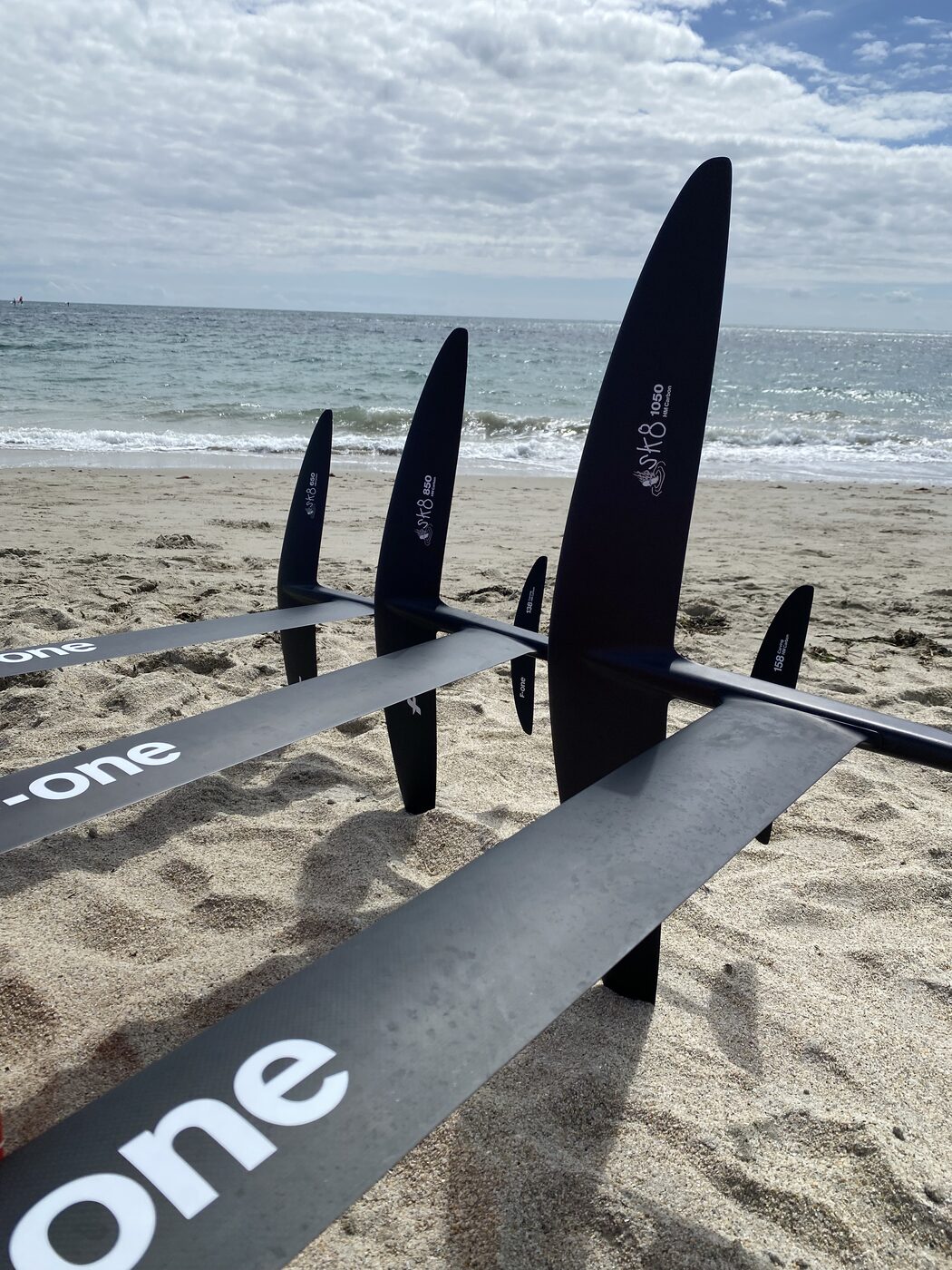
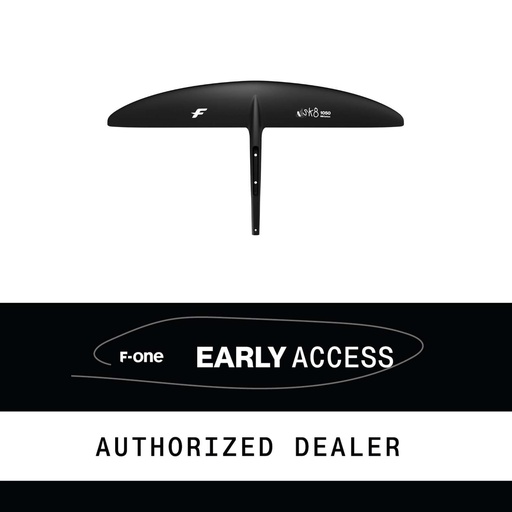
The F-One SK8 V3 2026 is F-One's carving and Surf foil Front Wing: aspect ratio 8.0, monobloc HM Carbon, Titan 2 connection, and ultra-high modulus 12 mm mast.
The third generation of the SK8 is easier and more forgiving than the V2, available in 7 sizes (550 to 1150 cm²) from €799 to €1.019. Take-off is now linear, carving is benchmark, and it offers great stiffness, but it's a surfer's foil above all, demanding for pumping.
Who is the SK8 V3 for?
The SK8 V3 is for you if you want to Surf and carve above all, if you're coming from the V2 and looking for more ease and precision, or if you do wing foil and want an allround foil that's very accessible in larger sizes. Conversely, if you want to pump for a long time and reconnect as many waves as possible, the F-One Eagle (aspect ratio around 9.5) will be more suitable; and if you're new to Surf foil, go for a large size (950 or 1050) for more tolerance.
Which SK8 V3 size to choose?
Seven sizes, from 550 to 1150 cm². The feedback on conditions below concerns the sizes the Coste family rides all year round (650, 850, 1050); for the others, we only indicate the positioning, without inventing any feelings.
| Size | Price | Stab | Who it's for |
|---|---|---|---|
| 550 cm² | €799 | 138 XS | Light advanced rider, strong wind |
| 650 cm² | €819 | 138 XS | Advanced, medium to strong wind (from 20 knots) |
| 750 cm² | €859 | 138 XS | Transition between 650 and 850 |
| 850 cm² | €899 | 158 XS | The allround reference, one foil for everything (from 15 knots) |
| 950 cm² | €949 | 158 XS | Progression, beginner Surf foil |
| 1050 cm² | €989 | 178 XXS | Light wind and progression (14-16 knots) |
| 1150 cm² | €1,019 | 198 XXS | Very light wind, heavy rider |
Not sure about your choice? We ride with all three sizes year-round in Pornichet: contact us to dial in the right size for you.
SK8 V3 Technical Specifications
| Feature | F-One SK8 V3 2026 |
|---|---|
| Type | Foil Front Wing, carving / Surf / wing |
| Aspect ratio | 8.0 |
| Construction | Monobloc HM Carbon (pre-preg carbon) |
| Connection | Titan 2 (2 M8 screws, mast fitted into the fuselage) |
| Compatible masts (tested) | Ultra High Modulus 12 mm and UHM Carbon 14 mm |
| Sizes | 550 to 1150 cm² (7 sizes) |
| Price | from €799 |
Our detailed review of the F-One SK8 V3
We gathered three complementary perspectives: the Coste family (Cyrille and Sylvie), who ride the SK8 V3 all year round in 650, 850, and 1050 in Pornichet (UHM 14 mm mast); Clément Danglot in Surf foil (SK8 V3 850, 12 mm mast); and Hydro Gav, international tester (SK8 V3 850, UHM Carbon 14 mm mast, 80 kg, in wing, parawing, and Surf). Each observation is attributed to its author, without alteration.
Take-off and handling
Clément Danglot
For him, this is the most significant evolution of the V3: a take-off that has become very linear, smooth, progressive, and predictable, making it much more accessible than the V2. He attributes this linearity to the entire setup (12 mm mast, Titan 2 connection, re-worked profile) which filters out parasitic micro-movements.
Hydro Gav
From the very first session, he noted no adaptation was necessary, even when coming from another foil: he compares it to rediscovering a foil he has known for a long time. The qualities of previous versions are still there, but more accessible, and the foil remains fluid and predictable across the entire speed range.
Carving and transitions
Clément Danglot
The SK8 V3 confirms its DNA: it turns short, turns easily, and remains stable during maneuvers. The foot pressure is more precise than on the V2, and transitions are cleaner, without unexpected stalls.
Hydro Gav
He describes exceptional roll rate and cornering control: you can place the foil exactly where you want it, with fast, precise response. Tacks and jibes, in both wing and parawing, are easily executed. His 850 setup with the Monobloc Carving Tail 158 at 80 kg proved particularly successful.
Stiffness, mast, and Titan 2 Connection
Clément Danglot
The mast is now 12 mm with a regressive chord, made of ultra-high modulus pre-preg carbon, for a claimed 25% increase in stiffness over the 14 mm. On the water, it confirms: despite its slimness, it's even stiffer than the old one, and control is superior. The Titan 2 connection (the mast slots into the fuselage, 2 M8 screws) reinforces the assembly and simplifies setup on the spot.
Hydro Gav
He chose the UHM Carbon 14 mm T2 mast: he had noticed ventilation issues with the 12 mm on large Front Wings (in his Eagle V2 review), which completely disappeared with the 14 mm. He prefers the added stiffness to the slight speed gain of the thinner mast. He also highlights the Monobloc system, which is plug-and-play and has no performance loss: no more setup uncertainties.
Speed, Pumping, and Limits
Clément Danglot
In terms of pure speed, the V3 remains similar to the V2: the reinforced Titan 2 fuselage balances the gain from the thinner mast. It's not a speed foil; it's a surfer's foil. For pumping, with its 8.0 aspect ratio, you have to put in the effort; to reconnect a maximum of waves with less effort, he recommends the F-One Eagle (AR around 9.5), which is complementary, not competitive.
Hydro Gav
Same observation, in detail: pumping is demanding (staying high on the mast, being dynamic, good technique). He linked three or four waves without issue in good conditions, but the exercise is unforgiving of timing errors; the stall speed, however, remains low. On flat water, glide is limited, even if it remains fun downwind on short bumps. For Foil Drive, he speaks of a remarkable combination, his only drawback being the absence, at the time of testing, of a compatible integrated carbon mast from F-One.
The Coste Family's Feedback, Size by Size
Coste Family
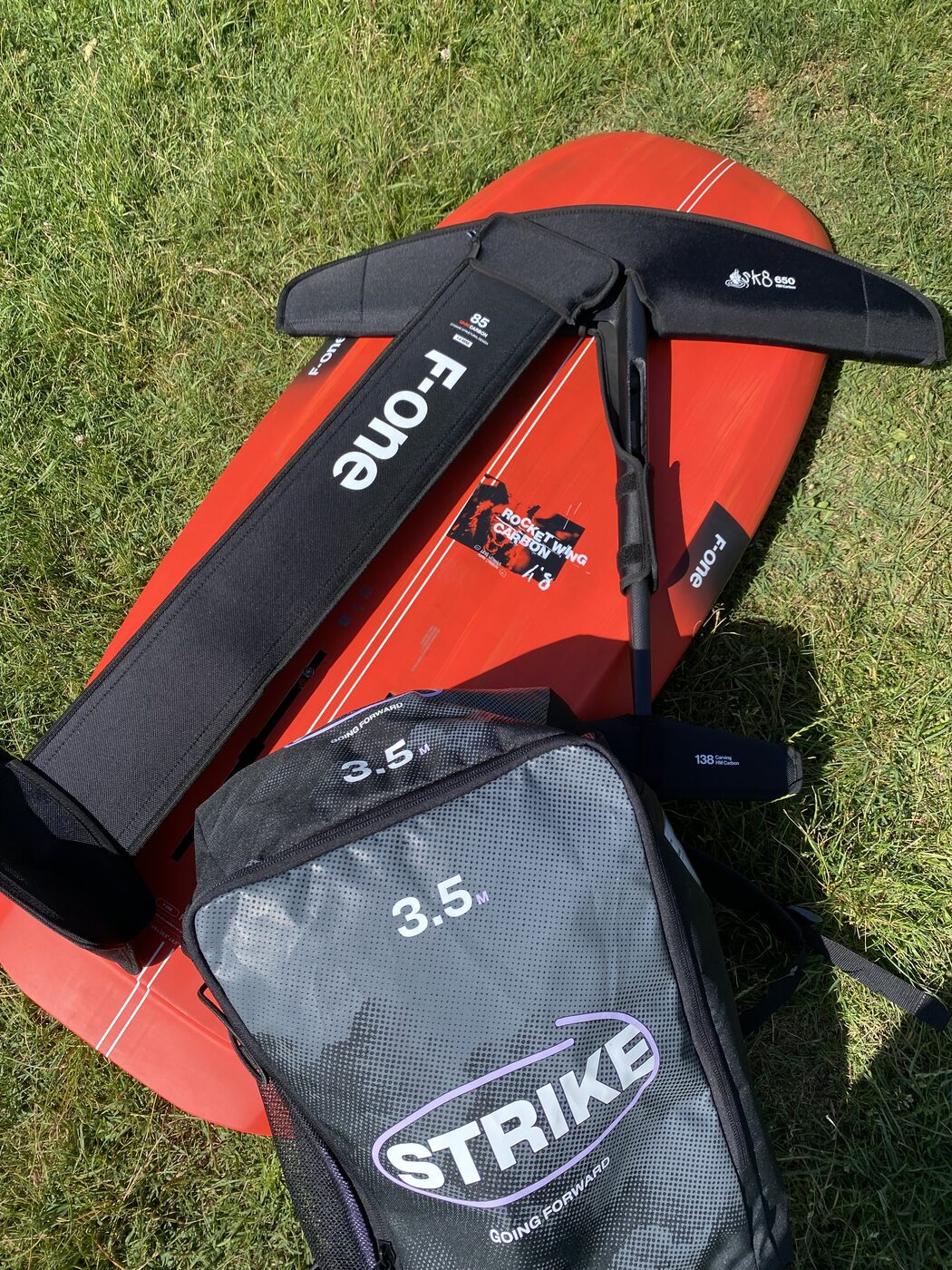
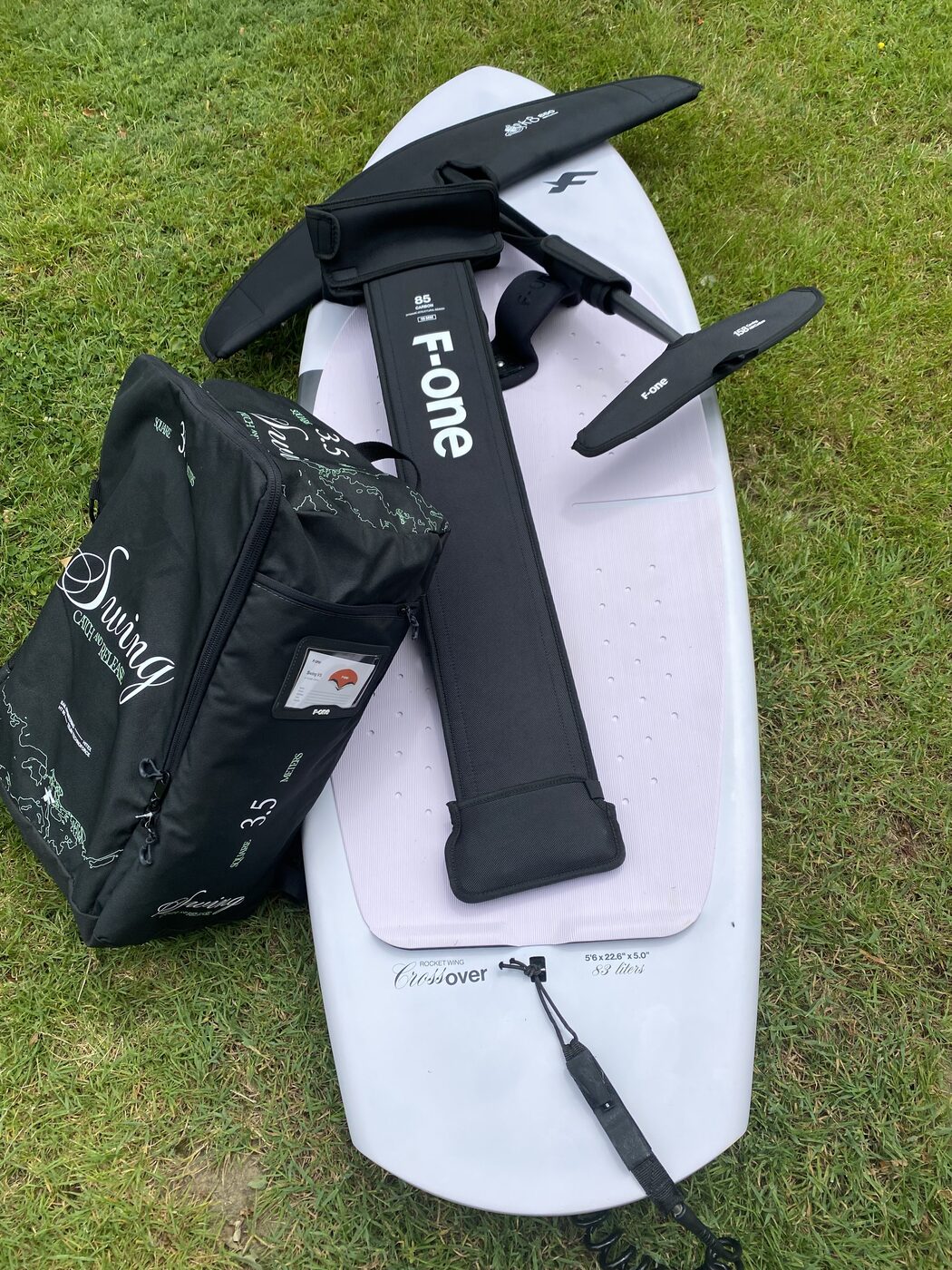
On the 1050 (stab 178), Cyrille describes a magical foil for light winds (tested in 14-16 knots): quick and fluid take-off, exceptional low-end, very stable and playful, and also ideal for parawing in 17-20 knots. The 850 (stab 158) is his allround reference from 15 knots, and Sylvie absolutely loves it from 20 knots. The 650 (stab 138) is his favorite from 20 knots: sharp, precise, and it doesn't stall even at low speed.
SK8 V3 or Eagle: Which to Choose?
The question often comes up, and the three testers agree: these are two complementary foils. Hydro Gav even describes the SK8 V3 + Eagle V2 duo as one of the best two-foil quivers he has ever used.
Choose the SK8 V3 if you want to carve, Surf, and have fun in the waves, with a stiff, precise, and easy foil.
Choose the Eagle if you want to pump for a long time, with glide and downwind capability, staying in the air as much as possible.
In Summary: Our Opinion on the SK8 V3
The F-One SK8 V3 2026 does things well: F-One has made it easier and more intuitive without sacrificing its strengths, carving, handling, and fun in the waves. The 12 mm mast provides impressive stiffness, the Titan 2 connection solidifies the entire setup, and the linear take-off opens the foil to more riders. For surfing, carving, and having fun, it delivers.
FAQ: F-One SK8 V3 2026
Is the F-One SK8 V3 Suitable for Beginners?
Yes, in large sizes (950 or 1050 cm²): maximum lift and tolerance for progression. Smaller sizes (550 to 750) remain performance foils, more demanding.
What's the Difference Between the SK8 V3 and the V2?
Take-off is now linear and intuitive, ultra-high modulus 12 mm mast is 25% stiffer, new Titan 2 connection and reworked profile. Carving is smoother and more precise. Pure speed remains at the V2's level.
SK8 V3 or Eagle: Which to Choose?
The SK8 V3 (AR 8.0) is made for carving, Surf, and waves. The Eagle (AR ~9.5) excels at pumping, glide, and downwind. They are complementary.
Which SK8 V3 size to choose?
1050 cm² for light wind and progression (14-16 knots), 850 cm² as an allround reference (from 15 knots), 650 cm² the most incisive for medium to strong wind (from 20 knots).
Is the SK8 V3 Good for Pumping?
No, that's not its purpose. With an aspect ratio of 8.0, it demands speed, energy, and technique. For reconnecting with as many waves as possible through pumping, the Eagle is more suitable.
Which masts is the SK8 V3 compatible with?
Only F-One Titan 2 masts (2 M8 screws). Tested with the ultra-high modulus 12 mm mast and the UHM Carbon 14 mm. Available from €799, in 7 sizes from 550 to 1150 cm².
We'll help you choose
No need to live in the area: call us or make an appointment (phone or video call) with a rider from the team. We'll advise you remotely to find the right size and setup for your build and your spot.
Make an appointment Call us Email us
Sources: field feedback from the Coste family (Cyrille and Sylvie, SK8 V3 650 / 850 / 1050, UHM 14 mm mast), test by Clément Danglot (SK8 V3 850, 12 mm mast) and review by Hydro Gav (SK8 V3 850, UHM Carbon 14 mm mast). Adapted and synthesized by GlissEvolution, without distorting the testers' comments.
 F-ONE
F-ONE