Guide Wingfoil, quelle est la meilleure aile ?
Une aile de wingfoil est une aile gonflable tenue à la main, sans lignes ni barre, dont le comportement dépend de trois éléments : le spi (canopy), le matériau du bord d'attaque et le type de prise en main, poignées souples, poignées rigides ou boom. C'est le programme visé, freeride, surf, race ou freestyle, qui doit décider du modèle.
📌 Quick Answer
The best wingfoil wing depends on your use. For allround freeride, the Duotone Slick (with mini-boom) and the F-One Strike (lightweight, high-performance for freefly) are the benchmarks. For performance, Duotone's D/Lab versions and the Ozone Flux dominate thanks to advanced materials (Allula, MOD3). With a boom, the Duotone Slick and the Eleveight WFS offer the best stiffness/stability compromise. Rigid handles (Unit, GT One) represent the future of winging.
Wingfoil Wing Comparison Guide: How to Choose Your Wing
To choose your wingfoil wing well, it's essential to define your use. Gone are the days when there were only allround wings. As in kitesurfing, wings are now designed differently according to their use: freeride, surf, race, freestyle. Some models are very allround, while others are more specialized.
In this article, we will examine wing constructions and their materials, riding qualities, the choice between soft, rigid handles or boom, and the weight of each model. We will only discuss the wings we know and sell at GlissEvolution.
Summary
Production Factories and Material Choice
The two most prestigious factories for producing wing and kitesurf wings are located in Sri Lanka: Aqua and GSL. Major brands like Duotone, F-One, Eleveight, HB, North, Ozone, Ensis, and Core compete for spots in these factories, ensuring production quality. Other factories also exist in Vietnam and China.
The choice of materials used for the canopy and Leading Edge is crucial: it determines the wing's strength, stiffness, lifespan, and price.
The Canopy (spi)
Classic canopy fabric (Teijin), historically used in kitesurfing, is not ideal for wingfoiling. Although lightweight, it is not resistant enough to elongation and ages poorly: after several dozen sessions, the profile deforms, leading to a loss of power and control.
New materials are changing the game:
MOD3 (Duotone): used on approximately 70% of the wing. 2x higher elongation resistance in the direction of the fibers, 3x diagonally. Better profile retention and durability.
TECHNOFORCE D2 (F-One): 66g stiffer canopy, applied to ~30% of the surface (Trailing Edge).
X-PLY (Reedin): launched in 2022 on the Super Wing X, it offers exceptional stiffness but adds weight.
In the short term, classic 50g/m² canopy will no longer be used on high-end wingfoil wings.
The Leading Edge Dacron
In kitesurfing as in wingfoiling, Dacron has long been the standard for the Leading Edge. New materials (high-modulus polyester, Dyneema) offer significantly superior performance: thinner Leading Edges for better upwind performance, struts with specific curves, deeper and stiffer profiles.
By brand:
Allula (Duotone D/Lab): 50% less weight than Dacron, 7x more tear resistant.
Penta TX (Duotone SLS): 15% less weight, 5x higher tear resistance, 50% less aspect ratio.
XTC Tex (Eleveight): high-modulus polyester, used on the GT One+.
Ho'okipa Ultra PE (Airush): ultra-high molecular weight polyethylene, 15x the pull of steel.
HITEX (F-One): high-tenacity polyester, 178g in the center and 158g at the ends (Strike V3, CWC).
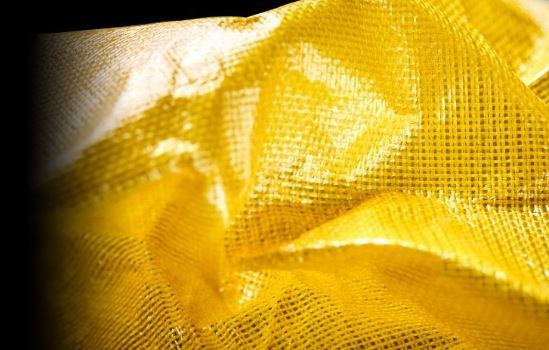

The advantages of new materials are numerous: lightness, waterproof fabric that doesn't soak up water, better UV resistance, and greater strength against tears and abrasions. The gains in flight are significant: speed, lift, low end, pumping, drift, and wider wind ranges.

Boom or handles?
The debate between using a boom or handles is in full swing. Duotone and Eleveight pioneered wings equipped with a boom.
Wings with a boom
Duotone Echo: the first model with a boom covering the entire width of the wing.
Duotone Slick: equipped with a mini-boom and an inflatable strut, offering maximum stability and immediate power.
Eleveight WFS: boom + inflatable strut for easy handling and fun sessions in all conditions.
At GlissEvolution, we find that booms offer many advantages: better grip, profile stiffness improving pumping efficiency, and stability in freefly. Carbon booms limit the added weight. The Duotone Slick V3 is sometimes even more stable than the Unit V3 without a boom.
Rigid handles: the future of winging
The Eleveight GT One, the Duotone Unit V4 and Unit D/Lab, as well as the light wind models Duotone Ventis and Ventis D/Lab, offer rigid handles that provide an excellent compromise:
Improved stiffness: better connection with the wing for optimal control.
Flexible hand placement: wide choice of hand positions.
Minimal weight: almost negligible added weight.
During transitions, the grip is highly appreciated, making maneuvers simpler and more intuitive. This configuration seems to represent the future of wingfoil for Duotone and Eleveight.
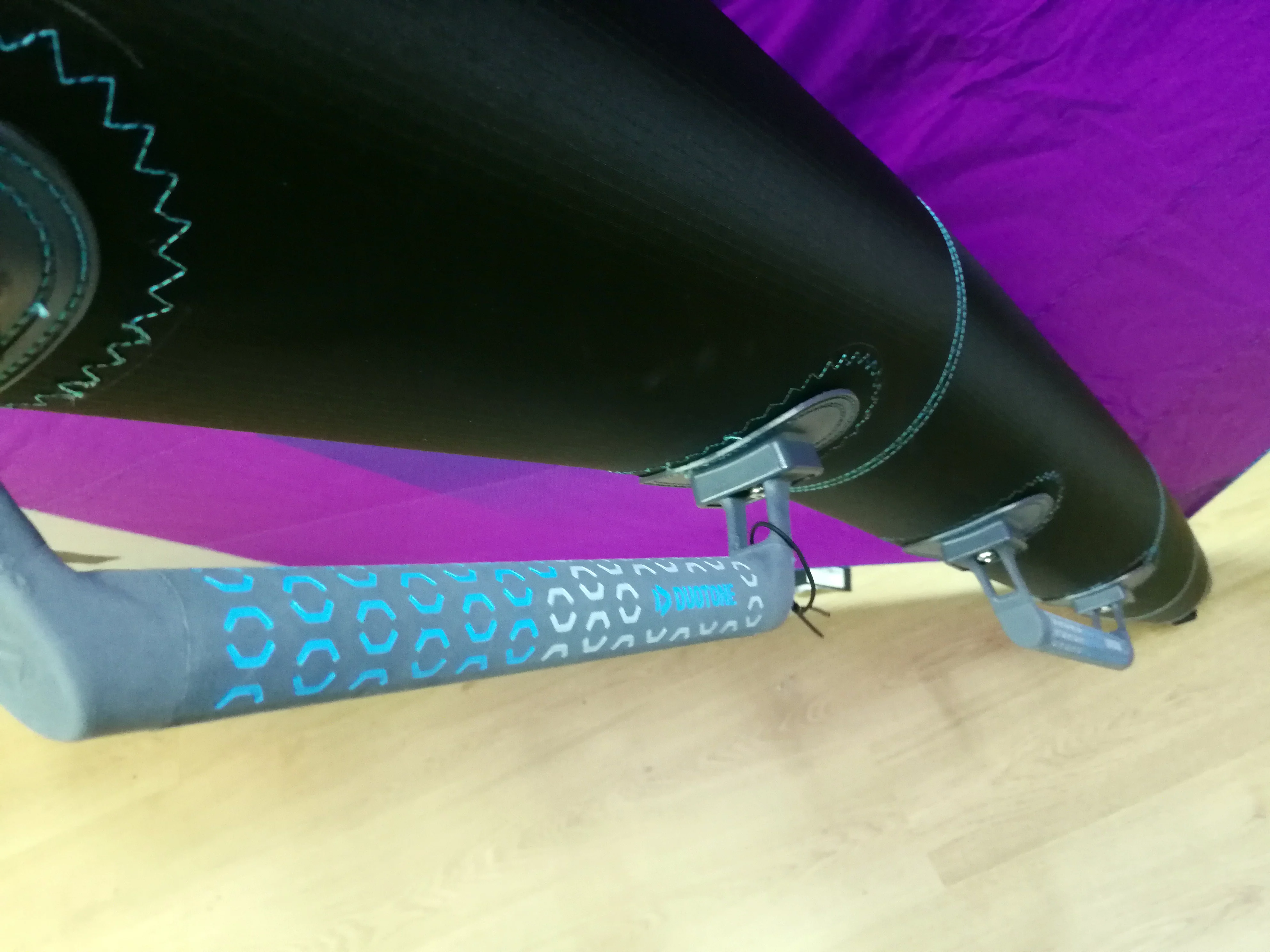
Wingfoil Wing Weights by Brand and Model
In wingfoil, wing weight is crucial, especially in light wind and for freefly. The lighter the wing, the less arm fatigue and the less it flaps during freefly. Here are the weights recorded by our team for the main wings on the market.
Duotone
| Model | Size | Weight |
|---|---|---|
| Slick | 2.5m² | 1.34 kg |
| Slick | 3m² | 1.52 kg |
| Slick | 4m² | 1.87 kg |
| Slick | 5m² | 2.15 kg |
| Slick | 6m² | 2.50 kg |
| Slick | 7m² | 2.77 kg |
| Unit | 3.5m² | 1.90 kg |
| Unit | 4.5m² | 2.30 kg |
| Unit D/Lab | 4m² | 1.85 kg |
| Unit D/Lab | 5m² | 2.19 kg |
| Unit D/Lab | 6m² | 2.49 kg |
Slick: weight without boom. Unit: weighed with handles.
F-One
| Model | Size | Weight |
|---|---|---|
| Strike | 3m² | 1.70 kg |
| Strike | 4m² | 2.00 kg |
| Strike | 5m² | 2.30 kg |
| Strike | 5.5m² | 2.50 kg |
| Strike CWC | 6m² | 2.94 kg |
| Strike CWC | 7m² | 3.22 kg |
| Strike CWC | 8m² | 3.46 kg |
Eleveight
| Model | Size | Weight |
|---|---|---|
| GT One | 3m² | 1.69 kg |
| GT One | 4m² | 2.04 kg |
| GT One | 5m² | 2.42 kg |
| GT One | 6m² | 2.70 kg |
| WFS V4 | 3m² | 2.13 kg |
| WFS V4 | 5m² | 2.76 kg |
| WFS V4 | 6m² | 2.96 kg |
WFS V4: weighed with boom.
Ozone / Reedin
| Model | Size | Weight |
|---|---|---|
| Ozone Flux | 3m² | 3.89 kg |
| Ozone Flux | 4.3m² | 4.43 kg |
| Ozone Flux | 5m² | 4.65 kg |
| Ozone Flux | 6.5m² | 5.15 kg |
| Reedin Super Wing X | 3.6m² | 2.70 kg |
| Reedin Super Wing X | 4.2m² | 2.90 kg |
Ensis
| Model | Size | Weight |
|---|---|---|
| Spin | 3.1m² | 2.20 kg |
| Spin | 3.6m² | 2.35 kg |
| Spin | 4.1m² | 2.60 kg |
| Spin | 4.6m² | 2.70 kg |
| Spin | 5.2m² | 2.90 kg |
Choosing Your Use: Which Wing for Which Discipline?
Today, several disciplines converge on the water: race, wave, carving freestyle, and freeride. Each practice has its preferred wings.
Race and Performance
Riders are drawn to race, using the highest-performance wings with the latest materials. Top picks include: Duotone Ventis and Ventis D/Lab, Duotone Slick D/Lab, Ozone Flux (carbon handles), and Airush Freewing Pro. To compete with the best times, choosing these high-performance wings is essential.
Surf, Carving, and Downwind
For carving, downwind, and surfing swells, we recommend boom wings. The freefly handle at the end of the boom makes it easy to quickly recover the wing and its power. Wings with soft or rigid handles are also very high-performing. Choose a comfortable wing that allows you to focus on the foil rather than piloting.
Freestyle
Younger riders opt for freestyle, seeking the adrenaline of aerial tricks. Compact and maneuverable wings are preferred.
Freeride
Allround and "family-friendly" use, ideal for relaxed sessions. Prioritize stability, ease of piloting, and comfort over pure performance.
Wingfoil Wing Models in Detail
Duotone Unit / Unit D/Lab
Power concentrated at the front for optimal lift, ideal for jibes and tacks. The D/Lab version is 15% lighter and 50% stiffer than the Dacron version. Designed for drift, stable in waves and swell. Excels in all disciplines.
Duotone Slick / Slick D/Lab
Mini-boom for maximum stability and immediate power. Optimized canopy for minimal flapping in freefly. Versatile, easy to handle, ideal for all levels.
Duotone Ventis / Ventis D/Lab
Specifically designed for light wind and race. Stiff handles, premium materials. Dominates the podiums in competition.
F-One Strike
Versatile and lightweight, appreciated for its freefly performance. The new shape offers power and responsiveness in all conditions. HITEX construction for durability.
F-One Swing
Less performant but softer than the Strike, ideal for those who prefer soft handles and a comfortable, effortless ride.
Eleveight GT One
Dyneema construction (XTC Tex), soft handles convertible into stiff handles. An innovative system offering flexibility and excellent finish.
Eleveight WFS
Aerodynamic wing with boom, offering fun sessions in all conditions. Easy to pilot, recommended for freeride and beginners.
Ozone Flux / Fusion
Flux: carbon handles, revolutionary shape, and latest-generation materials for speed, lift, and stability performance. The benchmark in race.
Fusion: compact and maneuverable, low aspect ratio to prevent wingtips from touching the water.
Ensis / Reedin / HB / Airush
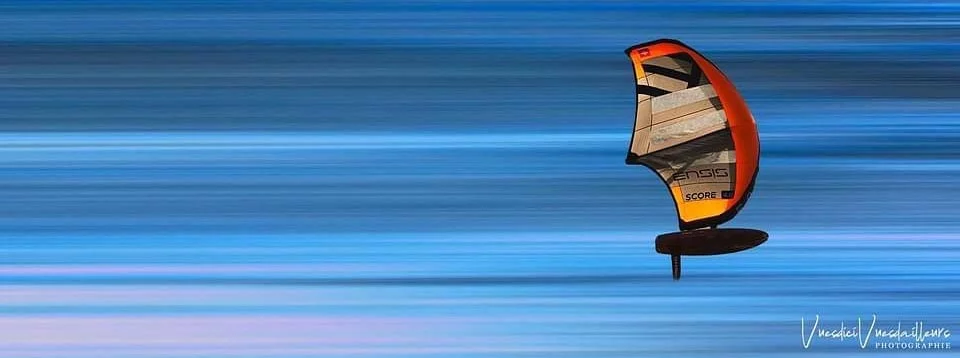
Ensis Score: light and stiff, stable in light wind, maneuverable in challenging conditions. Ideal for waterstarts and freestyle rotations.
Reedin Super Wing X: extremely stiff profile, unparalleled stability and silence in freefly thanks to X-PLY.
HB Guide/Flair: triradial structure dedicated to surf, made in France. Amazing stability in freefly.
Airush Freewing Pro: performance tuned for race, easy for everyday use.
Our Selection for Freeride Wingfoiling
For an optimal freeride experience, we recommend wings that are stable, powerful, and ideally compact. Here is our selection:
Duotone Slick - Allround, easy, mini-boom for stability
Eleveight WFS - Boom, exceptional handling
Eleveight GT One - Interchangeable soft/stiff handles
F-One Strike - Powerful, responsive, all conditions
F-One Swing - Smooth, comfortable, effortless
Ozone Flux - Carbon handles, high performance
Ensis Score - Powerful and compact
HB Flair - Made in France, exceptional stability
Tip: For excellent value, choose a discounted model from a major brand. These models offer better finish and superior performance compared to entry-level models at similar prices.
Discover our wingfoil wings

Frequently Asked Questions
What is the best wingfoil wing for beginners?
For beginners, opt for an allround and easy-to-pilot wing. The F-One Swing is known for its smoothness, the Duotone Slick for its stability thanks to the mini-boom, and the Eleveight WFS for its ease of use with the boom. In terms of size, a 4 to 5m² is suitable for most riders.
Boom or handles: which to choose?
The boom offers better grip, stiffness, and facilitates transitions. Rigid handles (Unit, GT One) are an excellent compromise with negligible added weight. Soft handles remain lighter but less performant. Test both if possible before buying.
What are the best materials for a wing?
Advanced materials outperform classic ripstop and Dacron. For the canopy: MOD3 (Duotone), TECHNOFORCE D2 (F-One), X-PLY (Reedin). For the Leading Edge: Allula (Duotone D/Lab), Penta TX (Duotone SLS), HITEX (F-One), XTC Tex (Eleveight). These materials offer more stiffness, lightness, and durability.
What size wing to choose?
The size depends on your weight and wind conditions. For a 75-85 kg rider: 5-6m² in light wind (12-18 knots), 4-5m² in medium wind (18-25 knots), 3-4m² in strong wind (25+ knots). Having a quiver of 2-3 sizes allows you to cover all conditions.
Which wing for wingfoil race?
The benchmarks in race: Duotone Ventis/Ventis D/Lab (light wind and speed), Duotone Slick D/Lab, Ozone Flux (carbon handles), and Airush Freewing Pro. These wings use the most advanced materials to maximize performance and lightness on the courses.
Explore our wingfoil categories
Discover our complete selection: wings, wingfoil foils, wingfoil boards and wingfoil packs.
Need advice on choosing your wing?
Our team of passionate riders is available in-store in Pornichet or by phone.
Ce qu'il faut retenir
| Section | À retenir |
|---|---|
| Wingfoil Wing Comparison Guide: How to Choose Your Wing | Pour bien choisir son aile de wingfoil, il est essentiel de définir son programme. |
| Production Factories and Material Choice | Les deux usines les plus prestigieuses pour la production d'ailes de wing et de kitesurf sont situées au Sri Lanka : Aqua et GSL . |
| The Canopy (spi) | Le spi classique (Teijin), historiquement utilisé en kitesurf, n'est pas idéal pour le wingfoil. |
| The Leading Edge Dacron | En kitesurf comme en wingfoil, le Dacron a longtemps été la norme pour le bord d'attaque. |
| Boom or handles? | Le débat entre l'utilisation d'un wishbone ou de poignées est en plein essor. |
| Wings with a boom | Duotone Echo : premier modèle avec un boom couvrant toute la largeur de l'aile. |
| Rigid handles: the future of winging | L' Eleveight GT One, la Duotone Unit V4 et Unit D/Lab, ainsi que les modèles vent léger Duotone Ventis et Ventis D/Lab, proposent des poignées rigides qui offrent un excellent compromis… |
| Wingfoil Wing Weights by Brand and Model | En wingfoil, le poids d'une aile est crucial, surtout en vent léger et en freefly. |
Frequently Asked Questions
Guide comparatif des ailes de wingfoil : comment bien choisir son aile : ce qu'il faut retenir
Pour bien choisir son aile de wingfoil, il est essentiel de définir son programme. Fini le temps où il n'y avait que des ailes polyvalentes.
Que faut-il savoir sur les usines de production et le choix des matériaux ?
Les deux usines les plus prestigieuses pour la production d'ailes de wing et de kitesurf sont situées au Sri Lanka : Aqua et GSL . Les grandes marques comme Duotone, F-One, Eleveight, HB, North, Ozone, Ensis et Core se battent pour obtenir des places dans ces usines, garantissant ainsi la qualité de production.
Que faut-il savoir sur le Spi (canopy) ?
Classic canopy fabric (Teijin), historically used in kitesurfing, is not ideal for wingfoiling. Although lightweight, it is not resistant enough to elongation and ages poorly: after several dozen sessions, the profile deforms, leading to a loss of power and control.
Que faut-il savoir sur le Dacron du bord d'attaque ?
En kitesurf comme en wingfoil, le Dacron a longtemps été la norme pour le bord d'attaque. Les nouveaux matériaux (polyester haut module, Dyneema) offrent des performances nettement supérieures : bords d'attaque plus fins pour une meilleure remontée au vent, lattes aux courbes spécifiques, profils plus creux et plus rigides.
Boom or handles?
Le débat entre l'utilisation d'un wishbone ou de poignées est en plein essor. Duotone et Eleveight ont été pionnières en proposant des ailes équipées d'un boom.
Que faut-il savoir sur les ailes avec boom ?
Duotone Echo : premier modèle avec un boom couvrant toute la largeur de l'aile. Duotone Slick : équipée d'un mini-boom et d'une latte gonflable, offrant une stabilité maximale et une puissance immédiate.
Sources et limites de ce comparatif
Ce guide croise les caractéristiques publiées par les fabricants et les retours de l’équipe GlissEvolution. Pour approfondir, consultez le guide officiel F-One pour choisir sa wing et la présentation officielle des matériaux D/LAB Duotone. Les sensations, la plage de vent et le choix d’une taille restent variables selon le poids, le niveau, le foil, la planche, l’état de la mer et la régularité du vent. Les gammes et constructions évoluent : vérifiez toujours la fiche du millésime concerné.
Une question sur le matériel évoqué ici ?
L'équipe GlissEvolution navigue sur ce qu'elle vend et répond de vive voix, au magasin de Pornichet ou par téléphone.