Surf skate Hana, la nouveauté chez Glissevolution.
Surf Skates in General:
David Colley and Brad Gerlach are the two Californian surfers credited with inventing the surfskate in the late 1990s, commercializing the first models under the Carver brand.
The surfskate is an essential accessory for watersports enthusiasts.
The main function of the surfskate is to replicate the sensations of surfing.
Thanks to its flexible front truck, it's possible to propel yourself without ever putting your foot down, using carving and pumping in a way comparable to a shortboard on a wave.
Difference Between a Surf Skate and a Skateboard
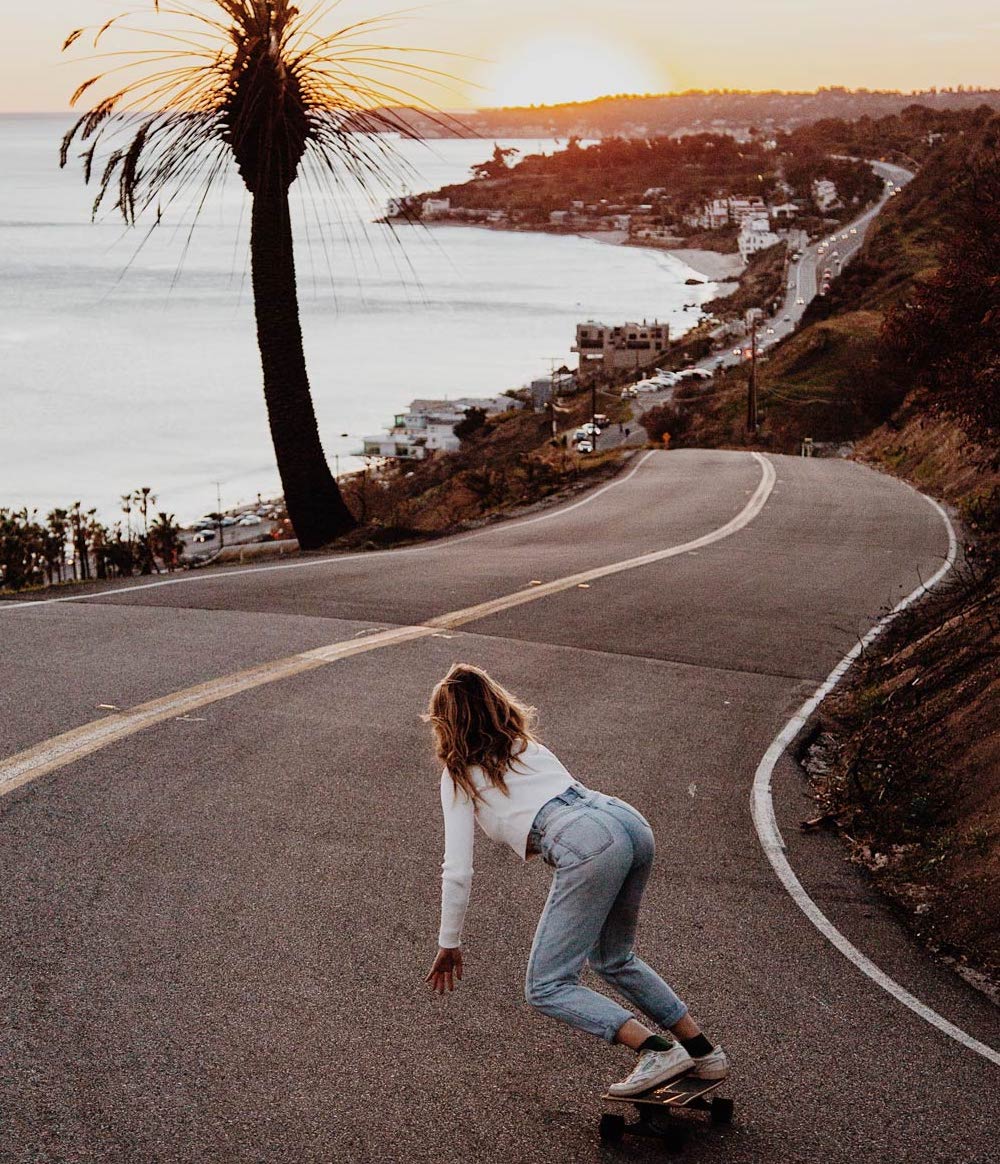
The surfskate is not suitable for freestyle, unlike normal skateboards, but you can try a few tricks with it!
With its flexible front truck, it allows you to move without ever needing to put your foot on the road, linking curves and tight turns, which is not possible with skateboards and longboards that have a rigid truck.
GlissEvolution's Opinion on the Hana Surf Skate
The surfskate Hana has a fast-reacting front truck, which provides an advantage in tight turns.
The deck is well-finished and composed of 7 sheets of maple wood, offering impressive lightness compared to its competitors.
The price is also an advantage for this surfskate Hana, as it possesses all the qualities of a surfskate at a competitive market price, typically around 200 / €300. It is priced at €195 for the surfskate and €185 for the cruiser.
Why get into surf skating:
Improve your technique
The surfskate will help improve your balance on the board, find the right eye and shoulder positioning to anticipate maneuvers, and also practice tricks like bottom-turns, cutbacks, rollers, front and back side, and many others.
Good for your health
The surfskate is a great way to stay in shape; it will help develop your balance, flexibility, and strengthen your thighs, abs, calves, and back with every session. This will keep you smiling even without water conditions.
Discover your city
The surfskate is a great way to replace bike rides, walks, or simply motivate yourself to get out of the house.
It's the ideal partner for discovering the perfect spot for surfskatepractice. You can also ride in skate parks or on pump tracks.
Mode of transportation
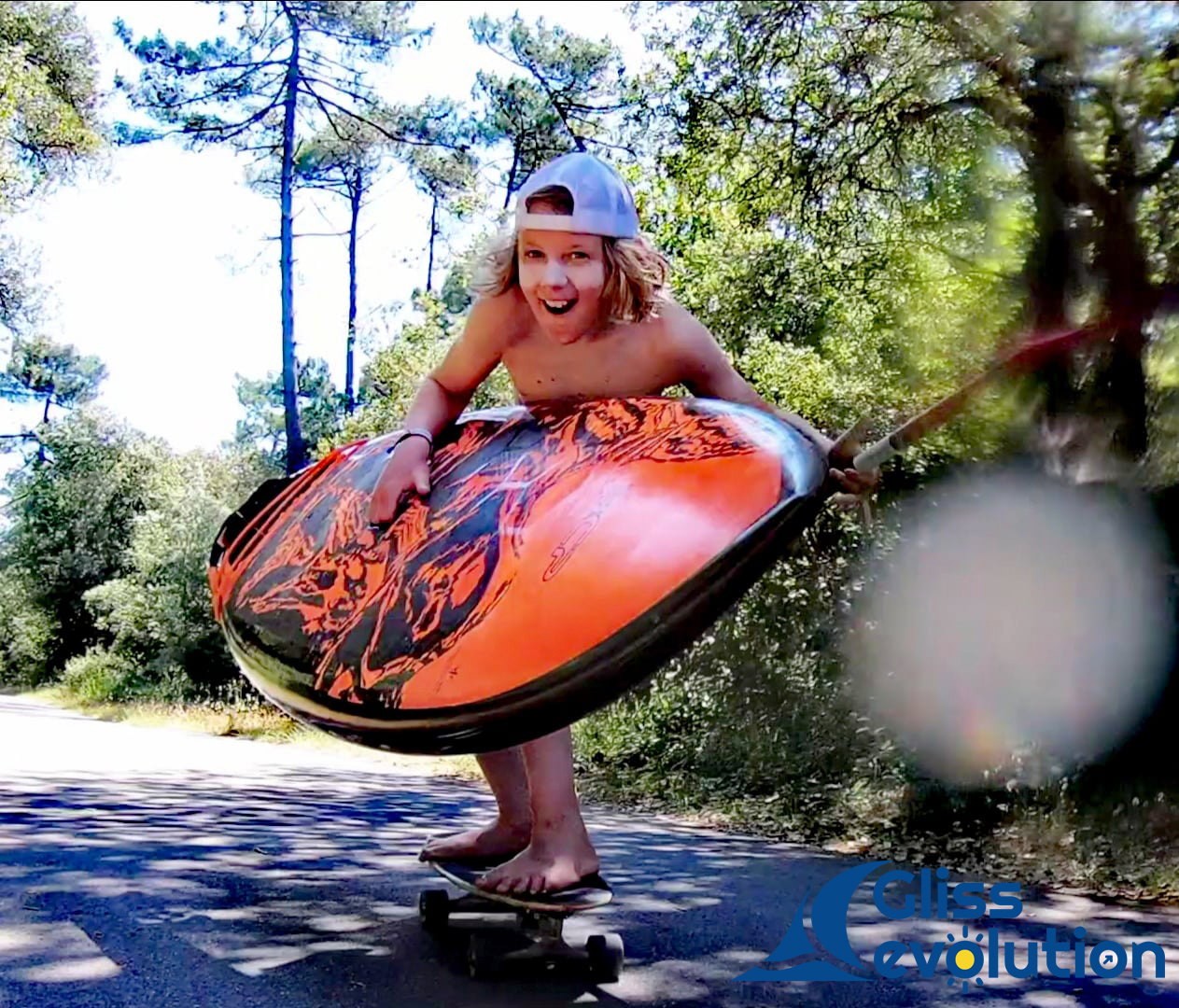
The surfskate is the ideal mode of transportation for commuting to work, running errands, and other activities.
When to use it:
For going to work! This allows you to rediscover the gliding sensations of the weekend.
The surfskate proves to be an essential tool for continuing to ride and rediscover those sensations when there are no conditions on the water.
However, it's not just useful when there are no conditions, but also for getting to the spot!
Getting to the spot on a surfskate gives you a taste of the session you're about to have, and also helps you warm up properly by working the muscles that will be used during your ride.
It's not just about the "pre-session"; there's also the "post-session," which means extending the pleasure of riding. Whether you had a good session or not, the sensations will be there.
How to use it:
Get on your surfskate like a traditional skateboard, and after your first push, the goal is to maintain speed through pumping.
Initially, try to shift your weight from your toes to your heels, drawing S-shapes. Keep your legs bent and your gaze fixed on where you want to go.
Just like in surfing, the front foot initiates the movement. Once you're more comfortable, shoulder movements and upper body engagement are amplified, allowing for greater speed.
Pumping is generated by upper body movements.
The Hana surf skate:
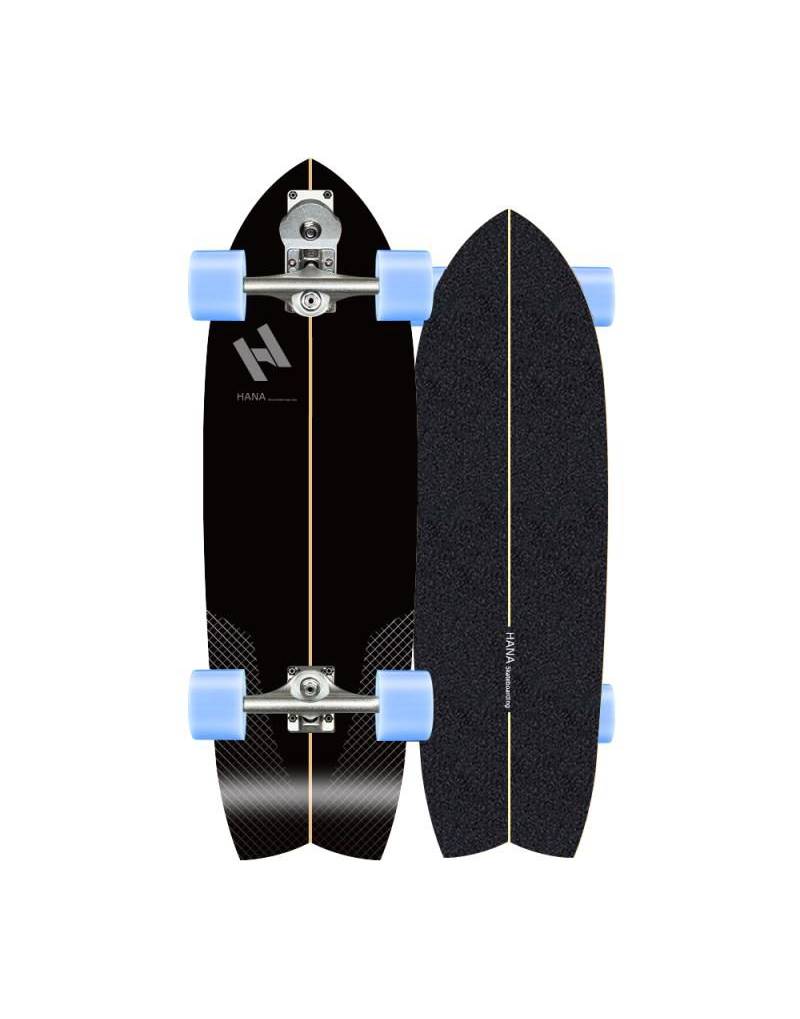
The surfskate Hana is perfect for all uses (cruising, pump track, bowl…) and it's available at GlissEvolution!
Thanks to its 33“ x 10.25“ swallow tail deck and 7-ply maple wood construction, it offers optimal comfort to users and allows for smooth maneuvers and turns thanks to its S7 truck!
An advantage of this surfskateis its soft 78A, 17mm diameter wheels, which allow you to ride even on rough asphalt.
There are 2 models in the Hana range:
The Surfskate The Cruiser Skate

The difference between a surfskate and a cruiser:
- A surfskate allows you to recreate the sensations of surfing with a wide deck, large wheels, and a more flexible front truck that recreates the feeling of gliding on asphalt as you would on water.
It's a perfect skate for maneuvers, as well as for pump tracks, bowls, and cruising.
However, its freestyle use is limited, and it's less stable than a cruiser, but it is extremely maneuverable, which is the real difference between these two skates.
- The cruiser , on the other hand, is a versatile and stable board, thanks to its wheels being larger and softer than a skateboard's. With the flexibility of its wheels, it will absorb road imperfections, making it ideal for rides.
Don't be fooled by its casual skate appearance, because thanks to its raised tail, it's possible to land tricks!
Technical terms to know
The different boards:
- the skateboard: a skate deck with two raised ends. It's the ideal skateboard for doing tricks.
- the cruiser : a versatile and stable board, thanks to its wheels being larger and softer than a skateboard. Perfect for urban travel over short distances, a cruiser allows you to overcome obstacles more easily than with a classic skate deck thanks to its larger wheels.
- The carver: Similar to the cruiser in shape and size, its front truck allows for very tight turns, mimicking those made by surfers.
- The longboard: The longboard is a skateboard longer than a classic skateboard, which allows for much higher speeds.
The different parts of the board:
- The board: also called the deck, it is mostly made of maple wood for most boards on the market.
- Size: refers to the size of your board. It is measured in inches (one inch = 2.54 cm).
- The tail: the rear part of your skate.
- The nose: the front end of your deck.
- The trucks: the steel component screwed to the board that connects the deck to the wheels.
- The wheelbase: the distance between your two trucks.
- The concave: corresponds to the curvature of the board. There are three types of concave: Low, Medium, and High concave.
- A set-up: we speak of a set-up when referring to a complete skateboard: board + trucks + wheels. A tool: this is not a part of your board but the tool you will use to change your trucks, wheels, and boards!
Skateboard parts:
- The axle: it's a screw placed in the center of the truck that can be tightened or loosened to adjust the board's flexibility when turning.
- The grip: the "black sandpaper" that covers the top of your skateboard deck, used to provide grip for your shoes.
- The pads: this is the rubber fixed between the skateboard deck and the trucks, used to absorb shocks when landing a trick.
- The bearings: there are two per wheel, and just like the wheels, they are essential for riding!
- The wheels: essential components of the skateboard. Without them, your board won't roll:-).
Basic Tricks:
- Manual: Instead of riding with all four wheels of the skateboard touching the ground, a skater performing a manual rides only on the two back wheels..
- Nose manual: Equivalent to a manual, but performed on the front wheels. It involves putting the skateboard in a position where only the front wheels are in contact with the ground, maintaining this balanced position, all while moving forward.
- Ollie: THE basic skateboard trick. It's a jump performed with the board.
- Nollie: when you perform an ollie by snapping your front foot on your nose.
- Backside 180: this is when you do a 180° with the board, rotating inwards.
- Frontside 180: when you do a 180° with the board, rotating backwards. These rotations can also be done switch/nollie/fakie.
- Fakie: Riding fakie means riding backward while maintaining the same stance on your skateboard.
- Boardslide: A trick where you slide on the center of your board along a rail.
- Shove-it: This trick involves a backside 180° rotation of the board; it's also called a Varial.
- Pop shove-it: This is the same principle as a shuvit but with popping your board.
- Heelflip: Performing a flip in the opposite direction of a kickflip. You rotate your board in the opposite direction with your heel.
- Kickflip: A trick where you make the board rotate one full turn along its parallel axis by flicking your foot to the side.
- Varial flip: Your board performs a pop shove-it accompanied by a kickflip.
Find all information about the Hana brand
Contact the store or our ambassadors to test your future kite or wing:
Duotone:
Seb: Facebook sebastien
Benjamin: Facebook benjamin
Kevin: facebook kevin
Nina: facebook nina
Eleveight:
Mourad:facebook mourad
Axel: Facebook axel
Alex: facebook alex
Louis: Facebook Louis
HB Surfkite:
Jeremy: Facebook jeremy
Flysurfer:
Obi Volant: Facebook olivier
Wing:
Kevin: Facebook kevin
Louis: Facebook Louis
Our Advisors:
Greg: Facebook greg specialized advisor kite, kite foil, wing foil.
Adrien: facebook adrien specialized advisor kite, kite foil, kite surf, wing foil, Surf.
François: facebook françois specialized advisor kite, kite foil, wing foil, Surf.
Shop's Facebook: GlissEvolution shop
Join the GlissEvolution Ride & Fun Family:
Facebook Group GlissEvolution ride & fun : https://www.facebook.com/groups/glissevolution.ride.and.fun/about
For more information, contact Greg, Adrien, or François at 09 62 64 74 77 or by email, info.glissevolution@gmail.com
or visit us at the GlissEvolution Store on the Port of Pornichet / La Baule.
Ce qu'il faut retenir
| Section | À retenir |
|---|---|
| Le surf skate en général | David Colley et Brad Gerlach sont les 2 surfeurs californiens à qui l’on doit l’invention du surf skate à la fin des années 1990 qui commercialisent les premiers modèles sous la marque… |
| Différence entre un surf skate et un skateboard | Le surf skate n’est pas adapté pour faire du freestyle, contrairement aux skateboards normaux, mais il est possible de tenter quelques figures avec ! |
| L'avis Glissevolution sur le surf skate Hana | Le surf skate Hana possède un truck avant qui réagit rapidement, ce qui procure un atout dans les virages serrés. |
| Améliorer sa technique | Le surf skate va permettre d’améliorer son équilibre sur la planche, trouver le bon positionnement du regard et des épaules pour anticiper les manœuvres, mais également de s’entraîner sur… |
| Bon pour la santé | Le surf skate est un bon moyen de garder la forme, il va permettre de développer son équilibre, sa souplesse, renforcer ses cuisses, ses abdos, ses mollets et son dos à chaque sortie. |
| Quand l’utiliser | Pour aller au boulot ! |
| Comment l’utiliser | Monter sur votre surf skate comme sur un skate traditionnel et après votre première impulsion l'objectif est de conserver la vitesse via le pumping. |
| Le surf skate Hana | Le surf skate Hana correspond parfaitement à tous les usages (ballade, pump track, bowl…) et il est disponible chez Glissevolution ! |
À considérer
Les points de vigilance et les limites relevés dans cet article :
- Cependant, il n’est pas utile uniquement lorsqu’il n’y a pas de conditions, mais également pour se rendre au spot !
- Il a cependant une utilisation freestyle limité et est moins stable qu’un cruiser, mais il est extrêmement maniable, ce qui marque la réelle différence entre ces deux skates.
Questions fréquentes
Que faut-il savoir sur le surf skate en général ?
David Colley et Brad Gerlach sont les 2 surfeurs californiens à qui l’on doit l’invention du surf skate à la fin des années 1990 qui commercialisent les premiers modèles sous la marque Carver. Le surf skate est l’accessoire indispensable des amateurs de sports de glisse.
Différence entre un surf skate et un skateboard : ce qu'il faut retenir
Le surf skate n’est pas adapté pour faire du freestyle, contrairement aux skateboards normaux, mais il est possible de tenter quelques figures avec ! Avec son truck souple à l’avant, il permet de se déplacer sans jamais avoir besoin de poser le pied sur la route et d’enchainer courbes et virages serrés, ce qui n’est pas possible avec les skateboards et les longboards qui possèdent un truck rigide.
Que faut-il savoir sur l'avis Glissevolution sur le surf skate Hana ?
Le surf skate Hana possède un truck avant qui réagit rapidement, ce qui procure un atout dans les virages serrés. Le plateau est bien fini, et est composé de 7 feuilles de bois d’érable qui lui offre une légèreté impressionnante vis-à-vis de ses concurrents.
Comment améliorer sa technique ?
Le surf skate va permettre d’améliorer son équilibre sur la planche, trouver le bon positionnement du regard et des épaules pour anticiper les manœuvres, mais également de s’entraîner sur les figures comme le bottom-turn, le cutback, le roller, front et back side et plein d’autres.
Bon pour la santé : ce qu'il faut retenir
Le surf skate est un bon moyen de garder la forme, il va permettre de développer son équilibre, sa souplesse, renforcer ses cuisses, ses abdos, ses mollets et son dos à chaque sortie. Ce qui va permettre de garder le sourire même sans conditions nautiques.
Quand l’utiliser ?
For going to work! This allows you to rediscover the gliding sensations of the weekend.
Une question sur le matériel évoqué ici ?
L'équipe GlissEvolution navigue sur ce qu'elle vend et répond de vive voix, au magasin de Pornichet ou par téléphone.