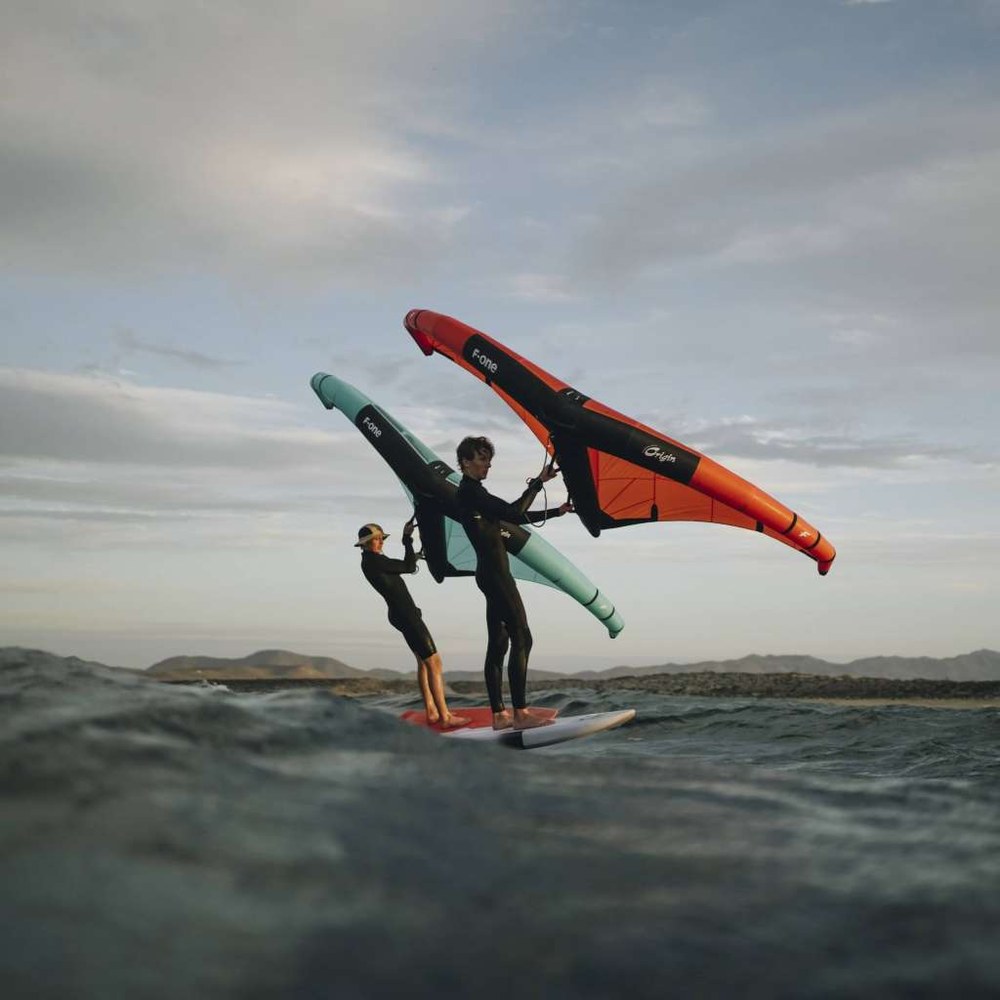
Wingfoil is a watersport where you fly above the water on a foil board, propelled by a handheld inflatable wing. Emerging around 2019, it is now the fastest-growing watersport in France, thanks to accessible learning and unique sensations from your very first sessions.
Which wing, board, and foil should you choose? What budget should you plan for? How can you progress quickly? At GlissEvolution in Pornichet, we have been equipping beginners for 21 years. Here is our complete guide to getting started and taking off in just a few sessions.
Wingfoiling is done with a handheld wing, a high-volume board, and a foil.
For beginners: a forgiving wing of 5 to 6 m², a board of at least 120 L, a foil with a large Front Wing (aluminum), and 6 to 10 hours of lessons. Complete budget: 1.800 to 2.€500 new, from 1.€200 second-hand. Our recommended pack: F-One Origin Gravity. Written by the GlissEvolution team, with 21 years of glisse expertise in Pornichet.
In 30 seconds: where to start?
- Basic equipment: a 5-6 m² wing, a 120-140 L board, an aluminum foil with a large Front Wing.
- Learning: 6 to 10 hours of lessons, flying in 3 to 5 sessions.
- Ideal wind for beginners: 12 to 18 knots, side or side-on shore.
- Complete budget: 1.800 to 2.€500 new, from 1.€200 second-hand.
- Recommended pack: F-One Origin Gravity 2025, starting from 1.€929.
What is wingfoil?
Wingfoil combines three elements:
- An inflatable wing, held at arm's length (no lines like kitesurf, no mast like windsurf).
- A board, with volume adapted to your weight for stability.
- A foil, the hydrofoil that makes you “fly” above the water.
Unlike kitesurf, you hold the wing directly in your hands: no lines to manage, no complicated take-off. This makes wingfoil more accessible and safer for beginners.
Why is wingfoil so popular?
- 10 to 12 knots are enough: less wind than kitesurf or windsurf.
- 3 to 5 sessions to fly: rapid progression with the right gear.
- Easy to transport: compact wing once deflated, space-saving.
- Anywhere: sea, lake, or any body of water, as soon as there's wind.
How to choose your gear?
The Wing: Size According to Your Weight
| Your Weight | Wing Size | Our Recommendation |
|---|---|---|
| < 65 kg | 4.5-5 m² | Origin V2 4.5 m² |
| 65-80 kg | 5-5.5 m² | Origin V2 5 m² |
| 80-95 kg | 5.5-6 m² | Origin V2 5.5 m² |
| > 95 kg | 6-7 m² | Origin V2 6 m², Swing V5 6 m², Float 6 m² |
All our wings · Read also: Origin Test, Swing V5 Test
The board: your weight + 30 to 40 liters
| Your Weight | Min volume |
|---|---|
| < 65 kg | 100-120 L |
| 65-80 kg | 110-130 L |
| 80-95 kg | 130-150 L |
| > 95 kg | 150-170 L |
The foil: prioritize stability
- Front Wing 1.500-2.000 cm²: large surface, easy take-off.
- 80 cm mast: a standard, versatile size you'll keep for all your riding.
- Aluminum: strong, affordable, perfect for learning.
Greg's take: 21 years of riding
"To get started, I always steer people towards boards of at least 120 L and forgiving wings. I've seen too many beginners get discouraged with overly technical gear. The F-One Origin Gravity complete set ticks all the boxes: stable wing, high-volume board, accessible foil. Come to the shop, and we'll let you try it."
The 4 steps to get started
- Mastering the wing on land: learn to hold the wing by the handles and orient it. Start in a neutral position facing the wind, then tilt it to generate power.
- Riding on your knees: on the water, start on your knees on the board. The goal is balance and wing management; the foil stays in the water.
- Standing up: bend your knees and look forward. Adjust the pressure on your feet to control the trim.
- Take-off: with speed, press on your back foot. As soon as the foil lifts, rebalance with your front foot. You're flying!
Our advice: take lessons before buying
Allow 2 to 3 hours for an introduction, but 6 to 10 hours to truly progress and become independent. It's the best investment to avoid discouragement. Our partner schools offer wingfoil introductory lessons. Once you've got your bearings, you can try the equipment at the shop to be sure of your choice before your first investment.
The 5 Mistakes That Make People Give Up
- Board too small: the number one mistake. Stability takes precedence over performance.
- Foil too technical: opt for a large Front Wing (1.500 cm² and more). An 80 cm mast is a good, versatile standard.
- Wind too strong: 12 to 18 knots maximum for learning. Beyond that, it's a struggle.
- Forgetting the wing leash: the wing flies away with the wind, and you're left in the water.
- Getting discouraged after 3 sessions: the first 5 are tough. After that, it's addictive.
Wingfoil or Kitesurf: Which to Choose?
Both sports are complementary but have important differences:
| Criterion | Wingfoil | Kitesurf |
|---|---|---|
| Minimum Wind | 10-12 knots | 15-18 knots |
| Learning Curve | 3-5 sessions to fly | 5-10 sessions to ride |
| Safety | No lines, simpler | Lines to manage, technical take-off |
| Feelings | Silent flight, pure glide | Speed, jumps, adrenaline |
| Bulk | Compact wing, high-volume board | Kite + bar + lines, smaller board |
| Beginner budget | 1 800-€2,500 | 1 500-€2,500 |
Our advice: wingfoil is more accessible for learning solo. Kitesurf offers more versatility (waves, freestyle, speed). Many riders do both.
Read also: Getting started with kitesurfing
What's the budget to start wingfoiling?
| Option | Budget | What you get |
|---|---|---|
| New complete set | 1 900-€2,500 | Compatible wing + board + foil, 2-year warranty |
| Inspected second-hand | 1 200-€1,800 | Gear checked in-store, 30-40% off |
| Mix new + second-hand | 1 500-€2,000 | New wing + second-hand board/foil |
Don't forget: add 150 to €300 for accessories (board leash, pump, bag). And plan for 200 to €400 for lessons, it's the most profitable investment.
Where and when to practice wingfoil?
Ideal conditions for beginners
- Wind: 12-18 knots, side or side-on shore.
- Water conditions: flat or small chop, deep water (1.50 m minimum for the foil).
- Temperature: bring a suitable wetsuit (3/2 in summer, 5/4 in winter on the Atlantic coast).
Spots around Pornichet
Our team regularly rides at these spots, perfect for progression:
- La Baule, large beach, ideal with South-West wind.
- Le Pointeau (Saint-Brevin), flat and accessible spot, but be careful of the bottom: prefer mid-tide minimum.
- Le Pouliguen, sheltered body of water, perfect for beginners.
Using Windguru to predict your sessions
Our 2026 Beginner Selection
After equipping hundreds of beginners in-store, here are our recommendations.
The recommended complete set: F-One Origin Gravity 2025 (from 1.€929)
F-One Origin Gravity 2025 combines an Origin wing (stable and forgiving, perfect for learning), an ASC board (generous volume, easy take-off), and a Gravity FCT foil (great lift, robust aluminum). Everything is compatible: you'll need to add handles, a board leash, and a pump to be operational. This is the set we recommend to 80% of beginners in the shop.
Previous year's wings on sale
Take advantage of sales on previous year's models:
- F-One Swing V4 2024 : from €695 (-40%).
- Duotone Unit V5 2025 : from €699 (-30%).
- Core XC : from €499 (-50%), compact and versatile.
Add a 120 to 140 L board (second-hand: 500 to €800) and a large surface aluminum foil (600 to €900). Estimated total: 1.800 to 2.€400.
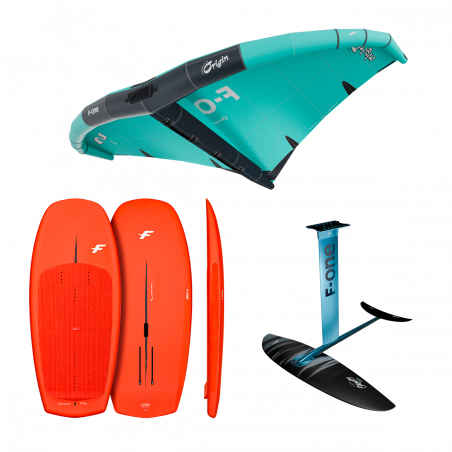
F-One Origin Gravity Pack
€1,929
Go further
Our guides to getting the right gear
Our tests of versatile wings
- F-One Origin Test: Our Beginner Recommendation
- F-One Swing V5 Test: Versatile and Progressive
- Duotone Unit 2026 Test: The Freeride Benchmark
Frequently Asked Questions
Can I learn without knowing how to surf or kitesurf?
Yes, absolutely. Wingfoil is accessible without prior experience. Allow 3 to 5 sessions to stand up and start flying, using a high-volume board and a stable foil.
Is it better to buy new or second-hand?
Both are valid. A new complete set (1.900-2.€500) offers a warranty and compatibility. Second-hand (1.000-1.€800) allows you to save 30 to 40%. Our selection of second-hand items is inspected in-store.
How many lessons before buying?
Allow 2 to 3 hours for an introduction to see if you like wingfoil. To progress and become independent, plan for 6 to 10 hours of lessons. It's the most cost-effective investment.
What wind speed do you need to ride?
As little as 10 to 12 knots with a large wing (6-7 m²). This is less than kitesurf (15 knots and up). To start, aim for 12 to 18 knots: enough to move, but not too much to maintain control.
Which complete set for a 2.€000 budget?
The F-One Origin Gravity 2025 pack at €1,929 is ideal: stable wing, high-volume board, forgiving foil. Everything is compatible and ready to ride.
Why buy from GlissEvolution?
21 ans d'expertise, une équipe de pratiquants qui teste le matériel à La Baule et Pornichet, un SAV France réactif, garantie 2 ans et livraison offerte dès 150 € (au mode de livraison le plus économique).
Need personalized advice?
We'll help you choose the right gear for your skill level, weight, and budget. Come visit us in-store in Pornichet or book a remote appointment.
Book an appointment Call us View wingfoil complete sets
Advice established by the GlissEvolution team, with 21 years of expertise in Pornichet. Indicative prices for 2026, subject to change. Wingfoiling should be practiced in suitable conditions: an introduction at a school is recommended before riding alone.