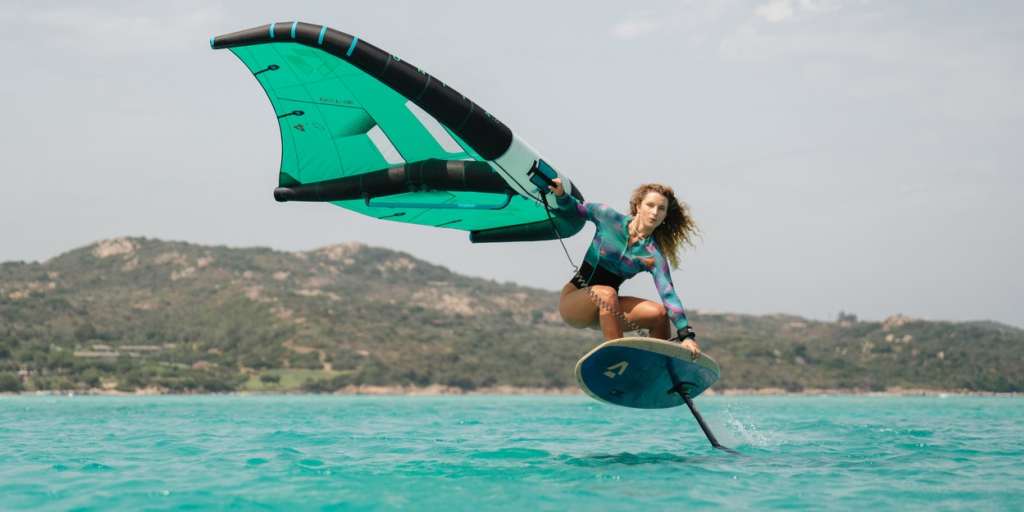
How to Choose Your Wing Foil Board (2026)
In 2026, the wingfoil market has exploded: shapes are evolving, materials are diversifying, and each board caters to a specific riding style. Finding the right board can quickly become a headache. This guide explains how to choose based on your weight, skill level, spot, and use.
What's inside: a volume/weight chart to choose the right size, clear benchmarks on modern shapes (midlength, freeride, downwind, compact), advice on constructions (Epoxy, Carbon, SLS, D-LAB) and the straps, and our tips for faster progression. This use: a volume/weight chart to choose the right size, clear benchmarks on modern shapes (midlength, freeride, downwind, compact), advice on constructions (Epoxy, Carbon, SLS, D-LAB) and the straps, and our tips for faster progression.
Table of Contents
Understanding Wing Foil Board Shapes
Before buying, it's essential to understand the shape, which is the general form of the board and how it influences your riding. Length, width, volume, and hull shape all play a decisive role in stability, take-off, and handling in flight.
Originally, riders used SUP foil or surf foil boards, often too long or too thin to take off efficiently. Since then, Duotone, F-One, Eleveight, and Armstrong have evolved their designs towards more compact, better-balanced, and more efficient boards for waterstarts. The trend today is towards midlength or crossover boards, which combine stability, glide, and control.
Different Shape Types
- Compact: ideal for freestyle and experienced riders. Short, lively, and responsive.
- Freeride / Allround: balanced shape and centered volume, easy take-off, good compromise between stability and handling.
- Downwind / Midlength: long, thin, and glidy, perfect for light wind, pumping, or long glides.
- Surf / Wave: narrower, rounded nose, and fluid outline for linking turns in the waves.
GlissEvolution's opinion: the ideal shape is the one that matches your skill level and use. Modern 2026 boards offer smoother flight sensations, better touch-down management, and increased compatibility with Foil Assist systems (like Foil Drive). A good shape will accompany you for several seasons.
How to Choose the Right Volume?
Volume is undoubtedly the most important criterion. It determines buoyancy, ease of take-off, and stability in flight. Too little volume makes starts difficult, while too much volume limits handling. Three main categories based on your skill level: beginner (your weight + 15 to 25 L, for easy take-off even in light wind), intermediate (your weight + 5 to 15 L, balance of lift/handling), and expert (close to your weight, or even 10 to 20 L below, for more responsiveness).
| Rider weight | Beginner | Intermediate | Advanced |
|---|---|---|---|
| 60-70 kg | 90-110 L | 75-90 L | 50-70 L |
| 70-80 kg | 100-120 L | 85-100 L | 60-75 L |
| 80-90 kg | 110-130 L | 95-110 L | 70-85 L |
| 90 kg and + | 120-140 L+ | 105-120 L | 75-90 L |
GlissEvolution's opinion: volume isn't everything; its distribution (centered or forward) greatly influences stability. For a first purchase, prioritize a stable and forgiving board with a flat hull shape and generous volume. Experienced riders will prefer more compact boards for better control.
The right board for your level
For a good start
Prioritize stability and ease of take-off: plenty of volume, a flat deck, and comfortable width to find your footing without losing balance. A handle under the hull shape, beveled rails, and well-distributed volume are a real plus for waterstarts and your first flights.
To progress
Freeride or midlength boards are ideal for taking the next step: a balance between glide, stability, and handling, perfect for linking transitions, surfing, or riding in irregular wind. This is the best option for frequent sessions, whatever the spot, without being too demanding, and they support progression over several seasons.
For committed riders
Advanced riders look for more compact, stiff, and precise boards: control in jumps, responsiveness for pumping, and a fluid glide in waves or downwind. Carbon or SLS construction, reactivity, and high-speed stability: they demand more skill but reward every session with pure sensations.
Technical details to consider
- Short length = more maneuverable: more reactive, ideal for quick maneuvers and freestyle.
- Width = stability for waterstart: facilitates take-off, especially in light to moderate wind.
- Centered volume = better lift: good buoyancy at the start and consistent speed without sinking.
- Flat shape = quick take-off: ideal in light wind, better glide and earlier planing.
- Concave shape = comfort: better pressure distribution for foot placement and transitions.
- Handle under the board = practical for transport, even in the water or for storage.
Which construction to choose?
Epoxy / Bamboo: ideal for beginner to intermediate, good strength-to-price ratio, durable, repairable, and comfortable for regular riding. Full carbon: lighter and stiffer, for more responsiveness and performance (glide, pumping response, freestyle, light wind, rapid progression). PVC Sandwich, SLS, D-LAB: the ultimate for demanding riders or competitors, ultra-light, extreme stiffness and maximum responsiveness, designed for intensive use.
Straps and two boards
Straps allow for better board control in demanding conditions (jumps, sinker starts). As a beginner, start strapless to understand balance and automate your foot placement, then add straps once you're comfortable. Experienced riders who want to jump, freestyle, or ride aggressively opt for straps, which offer better control in strong wind and for technical tricks.
Why have two boards? Rather than a single "do-it-all" board, many riders combine a larger, higher-volume board for light wind days with a smaller board for more aggressive sessions, waves, or jumps. This allows you to adapt better to conditions and maximize performance for every session.
FAQ: Choosing Your Wing Foil Board
Which board for beginners?
Choose a board with good volume for stability and easy take-offs, and an allround shape. Examples: Duotone Sky Start, F-One Rocket Wing ASC.
What size board should I choose?
Beginner: your weight + 15 to 25 L. Intermediate: your weight + 5 to 15 L. Expert: a volume close to your weight or slightly below for more handling.
Do I need a special board for light wind?
Yes: a larger board, such as a midlength or downwind type, offers more lift and an earlier take-off when the wind struggles to establish.
Is a larger board always better for beginners?
Not always: if too large, it can become difficult to handle in strong wind. You need to find the right compromise between volume, handling, and stability.
New or second-hand?
For beginners or intermediate riders, a second-hand board in good condition is a great option. For an expert rider seeking performance, a new board guarantees quality and durability.
Find the board suited to your use
Our wingfoil experts help you choose the right volume, shape, and construction according to your size, level, and usual conditions.
See all wing foil boards Contact us Call us
Also read
Source et limites : les repères ont été confrontés au guide officiel F-One sur le choix d'une planche de foil. Ils restent indicatifs : le bon volume dépend aussi du niveau, du shape, du plan d'eau, du vent et du foil utilisé. Pour débuter, privilégie la stabilité plutôt que le volume minimal.